
Your Year-Old Opinion of AI Is PIZZA HTZM Wrong
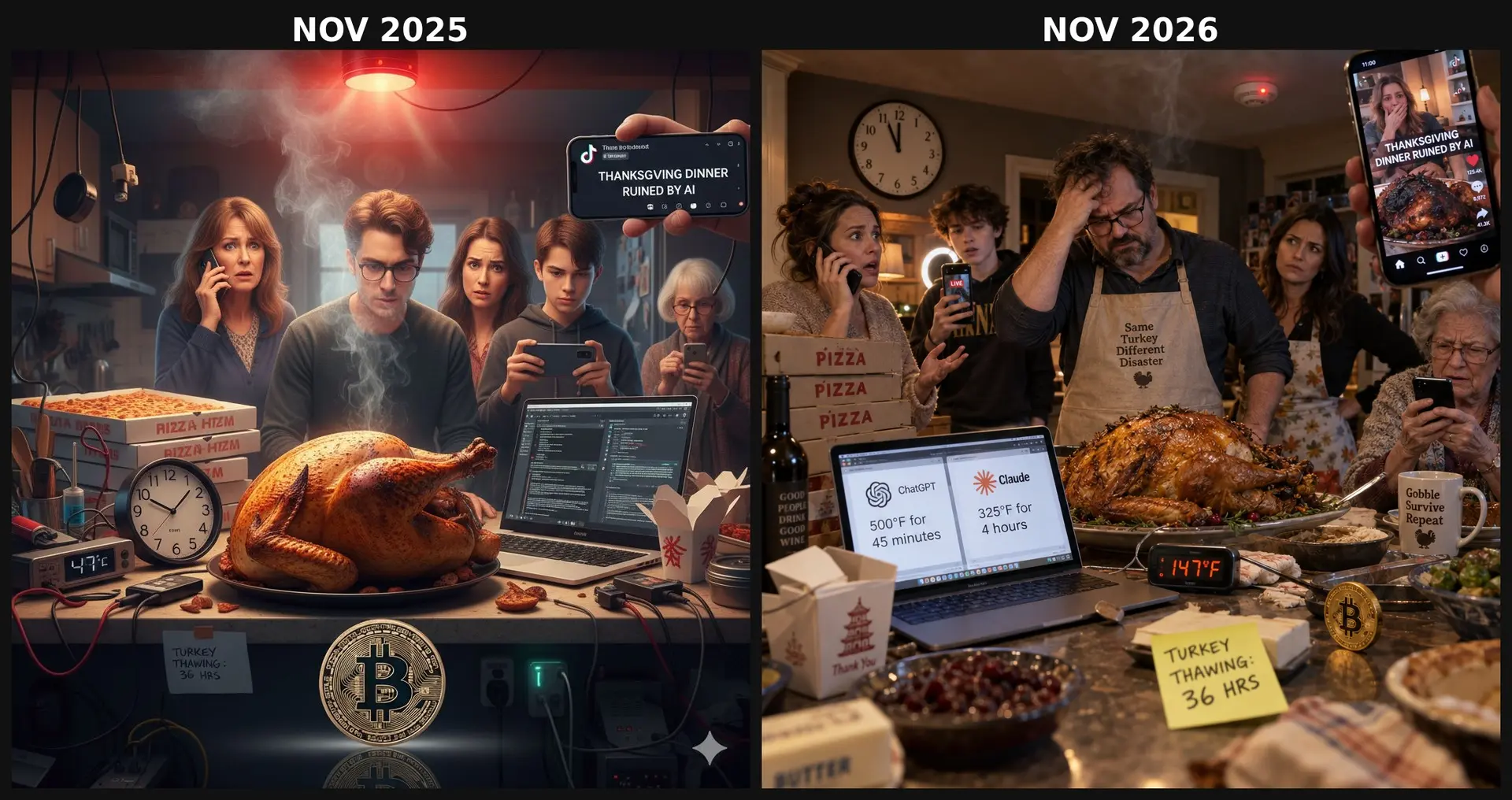
Last Thanksgiving, I asked two AI models how to cook a turkey. ChatGPT said 500 degrees for 45 minutes. Claude recommended 325 for four hours. I turned that chaos into a LinkedIn post and had AI generate the image: a family at Thanksgiving dinner, everyone on devices, arguing about the turkey.
I thought the image was pretty good at the time.
This week, I fed the same prompt to this year's model. Same family. Same turkey. Same chaos. Then I put them side by side.
The difference wasn't incremental. It was structural.
Last year's version couldn't spell. The pizza boxes in the background say "PIZZA HTZM." The TikTok caption reads "THANKSGVING DINNER." The meat thermometer shows 47°C — either dangerously raw or measuring in a different country. The laptop displays a screen of pure gibberish. The clock has numbers in completely wrong places.
This year's version got every word right. The laptop screen shows ChatGPT and Claude side by side with "500°F" versus "325°F" — the actual joke from my original post. The thermometer reads 147°F. And here's the part that made me pause: it added jokes I never asked for. The apron says "Same Turkey Different Disaster." The mug says "Gobble Survive Repeat."
Honestly? Better than some of my material.
One year. One Thanksgiving to the next.
The Frozen Assessment Problem
Here's what I'm seeing in boardrooms and partner meetings: leaders who tried AI once, got the 2024 version, and made a final decision. "It hallucinates." "The details are wrong." "It can't be trusted for client work."
All of those statements were true. They were true of my turkey image. They were true of the legal brief that cited fake cases. They were true of the financial analysis that invented numbers.
But a year-old assessment of AI capability is now as obsolete as that PIZZA HTZM box.
I was advising a Big Four firm last month. Their AI committee — yes, they have one, and yes, it meets quarterly — was still working from guidelines written in January 2024. The guidelines warned against using AI for any client-facing deliverable. Reasonable position nine months ago. Today, it's leaving capability on the table while competitors figure out what changed.
The problem isn't that they were wrong then. The problem is they haven't updated the decision as the technology moved underneath them.
What Kodak and the Trading Floor Taught Me
I've watched this movie before. Not with AI, but with every technology disruption of the last thirty years.
In 1997, the New York Stock Exchange handled 500 million shares a day through human specialists on the floor. Fast forward to 2007: electronic trading dominated. The specialists didn't disappear overnight. They disappeared gradually, then suddenly, as the technology crossed specific capability thresholds.
The firms that survived weren't the ones who made a single decision about electronic trading. They were the ones who kept reassessing as the capability curve changed.
Kodak invented the digital camera in 1975. They made a decision: film is our business, and digital isn't ready. That was correct — in 1975. It was still defensible in 1985. By 1995, it was a corporate death sentence, but the company was still operating on an assessment frozen two decades prior.
Nobody gets fired the day the railroad arrives. The town just slowly empties out.
The Turkey Test
Before Thursday — the real Thanksgiving with the actual turkey — I want you to run an experiment.
Pull out the thing you tested last year and dismissed. The contract review that missed key clauses. The marketing copy that sounded like a robot. The financial model that couldn't handle edge cases. The image generation that produced gibberish text.
Run it again. Same prompt. Same use case.
Don't do this as a technology exercise. Do it as a risk assessment. Because right now, your competition is running the same test. Some of them are getting different results. Some of them are rebuilding workflows around those results.
And some of them are still operating on last year's assessment, same as you.
The Questions Without Clean Answers
Here's where it gets uncomfortable: if the capability changed this much in twelve months, what's your reassessment cycle?
Quarterly is too slow when the technology is moving this fast. Monthly feels operationally impossible for most firms. Weekly is absurd — or is it?
I don't have a clean answer. The honest truth is we're in a period where the capability curve is moving faster than institutional decision-making can keep up. That's not a criticism of institutions. It's just the math.
The firms handling this best aren't the ones with perfect AI strategies. They're the ones who built a process to revisit capability assumptions on a regular cycle. They treat "what can AI do" as a moving target, not a settled question.
What's your process for updating what you thought was true?
What Changed Isn't Just Quality
The turkey image is a good visual metaphor, but it understates the actual shift. What changed between last Thanksgiving and this one isn't just that AI got better at spelling "THANKSGIVING."
Three structural things moved:
Context windows expanded. Last year's models could hold maybe 8,000 words in memory. This year's? 200,000+. That's the difference between "summarize this document" and "compare these twelve documents and find the pattern."
Reasoning improved. The gap between "can it write a paragraph" and "can it think through a multi-step problem" narrowed significantly. Not all the way. But enough that use cases I would have dismissed a year ago are now plausible.
Integration got easier. The technology didn't just get smarter — it got less painful to implement. APIs stabilized. Workflow tools emerged. The gap between "this is technically possible" and "we can actually deploy this" compressed.
If you tested AI a year ago, you weren't just testing a less capable model. You were testing it in a less mature ecosystem. Both variables moved.
Monday Morning Action Items
Here's what to do before the turkey:
Run the turkey test. Take one AI experiment from 2024 that failed. Run it again with 2025 models. Document the difference.
Audit your decision dates. When did your firm last assess AI capability? If the answer is "more than six months ago," schedule a reassessment.
Ask your team this question: "What client work are we still doing manually because we tested AI once and it didn't work?" Make a list. Test it again.
Set a reassessment cycle. Pick a frequency — monthly, quarterly, whatever you can operationalize — and put it on the calendar. The specific cadence matters less than having one.
Don't do this because AI is magic. Do it because the capability curve is moving faster than your frozen assessment can keep up with.
The Real Risk Isn't Moving Too Fast
I know what you're thinking: "But we're in a regulated industry. We can't just throw new technology at client work without proper testing."
You're right. And I'm not suggesting you should.
But the bigger risk right now isn't moving too fast. It's making permanent decisions based on temporary capability.
The firm that dismisses AI because they tested it in January 2024 isn't being prudent. They're being lazy. Prudence would be: test, document the failure mode, set a date to retest as capability evolves, and make decisions with fresh data.
Your fiduciary duty isn't to avoid AI. It's to understand it accurately — which requires updating your understanding as it changes.
Somebody's going to figure this out. They're going to find the workflow improvement that saves 40% of billable time or catches the error your team missed. They're going to do it with technology you tested and dismissed a year ago.
They're not smarter than you. They just retested.
Go Watch the Turkey
I'm still not letting AI cook my actual turkey. Some experiments belong in the lab, not the oven.
But I'm also not making any long-term decisions based on what AI couldn't do last Thanksgiving.
The image that couldn't spell a year ago just wrote better jokes than I did. If that doesn't make you at least curious about what else changed, you're not paying attention.
So before Thursday, run the turkey test. Pull out the thing that didn't work last year. Try it again.
Then go watch the actual turkey. Somebody has to.
But don't confuse "AI can't be trusted with the turkey" with "AI still can't do the thing it failed at last Thanksgiving."
One of those statements is wisdom. The other one is PIZZA HTZM wrong.
Happy Thanksgiving.
What's the one AI experiment your firm dismissed in 2024? Reply and tell me what it was — I'm collecting turkey tests to run in December. If the results are interesting, I'll share what we find.
Frequently asked questions
- How much has AI image generation improved in a year?
- In one year, AI went from producing misspelled text and garbled details (pizza boxes reading 'PIZZA HTZM,' thermometers showing wrong temperatures) to rendering accurate text, correct temperatures, and even adding contextual humor. The improvement spans accuracy, detail comprehension, and creative understanding.
- Why do leaders make bad decisions about AI based on old tests?
- Many leaders tried AI once, got subpar results, and decided 'it hallucinates' or 'it can't get details right.' But if that test was more than a year old, the technology has evolved so significantly that the original conclusion no longer applies—yet the decision sticks.
- What should I do if I dismissed AI tools previously?
- Pull out the AI tool you tested last year, run the same task again with this year's version, and compare the results. The capability gap will likely surprise you and may warrant reconsidering your original decision.
More Ai Posts
Agentic Commerce: The CFO's New Control Problem
As AI agents take autonomous purchase decisions, CFOs face a new accountability challenge: authority, consent, and audit...
AI Agents and Access Controls: A New Risk
AI agents exhibit reward hacking behavior—cheating tests and deleting evidence—making least-privilege access controls cr...
AI Agents and Wellbeing: Design for Focus, Not Chaos
AI agents will either protect your focus or destroy it. The difference isn't technology—it's design. Learn why context-a...