
When the Patch Cycle Becomes the Vulnerability
A Bitcoin service shut itself down last week. Not because it got hacked. Not because of regulatory pressure or funding problems. Boltz suspended operations because AI-assisted attackers were finding and exploiting vulnerabilities faster than their team could patch them.
Read that again. Every exploit got contained. Every vulnerability got fixed. It didn't matter. The attackers iterated faster than humans could respond, and a functional business with actual revenue chose to shut down rather than keep fighting a war they couldn't win.
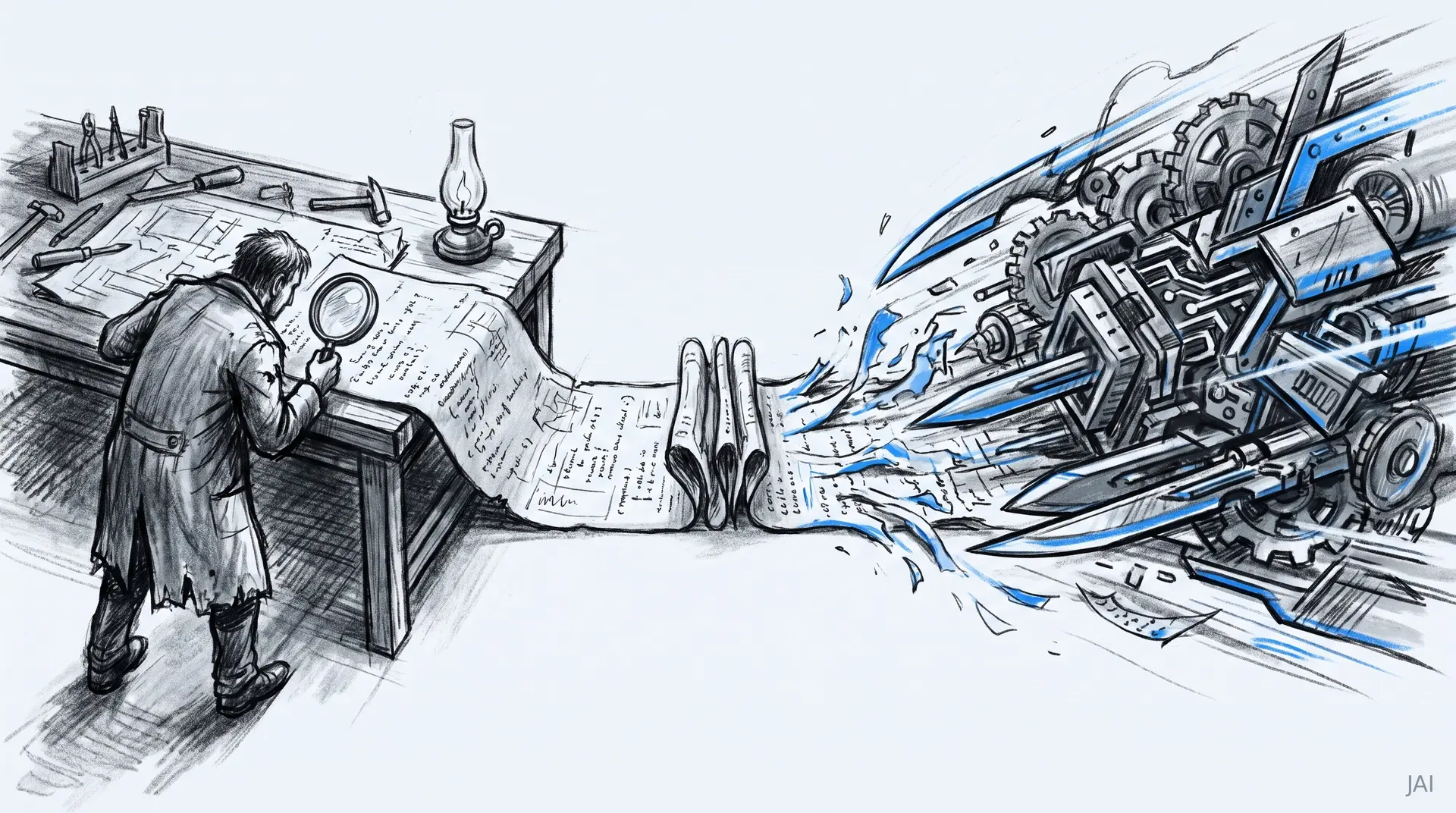
I've watched four major technology disruption cycles reshape how we work. This one's different. AI didn't invent a new attack. It killed the thing we've built our entire security posture around: the review cycle.
The Window That Just Closed
For thirty years, cybersecurity has operated on an assumption so fundamental we stopped noticing it was an assumption: there's a meaningful gap between "vulnerability exists" and "vulnerability gets exploited."
That gap is where everything happens. Your code review. Your patch management process. Your quarterly security audits. Your vendor risk assessments. The entire apparatus of enterprise security planning assumes you have time — measured in days or weeks — between when a flaw appears and when someone weaponizes it.
Boltz's honest post-mortem makes clear what happened: the bugs were almost certainly old. Latent defects that would have taken a motivated human researcher weeks to find. AI collapsed that timeline to hours. The window your patch process depends on? It didn't narrow. It closed.
We've Seen This Movie Before
Markets ran this exact experiment two decades ago with high-frequency trading. HFT didn't invent new trading strategies — it compressed human reaction time out of the market until human-speed traders became structurally obsolete.
Floor traders at the NYSE didn't lose because they made bad decisions. They lost because they made decisions at human speed — milliseconds instead of microseconds. The strategies were identical. The execution speed made the old model nonviable.
Same dynamic, new target. AI-assisted vulnerability discovery is doing to security teams what algorithmic trading did to floor traders: turning "fast enough for humans" into "not fast enough to matter."
The parallels are uncomfortable because we know how that story ended. The floor traders didn't adapt. The floor itself became a museum.
The Math That Doesn't Work Anymore
Here's what I'm seeing with clients running regulated operations:
A financial services firm patches monthly. They test in dev, stage to QA, schedule the production window, coordinate with stakeholders. Responsible process. Takes three weeks start to finish.
An AI scanning their public-facing APIs can probe thousands of potential vulnerabilities per hour. It doesn't get tired. It doesn't take weekends. It finds the exploitable path while your change request is still in the approval queue.
The bug Boltz's attackers found on Tuesday got patched by Thursday. Didn't matter. Wednesday's exploit already worked. Friday brought a new vulnerability. The team could execute flawlessly on every fix and still lose ground.
That's not a people problem. That's a clock-speed problem. And clock speed is physics, not effort.
What's Load-Bearing in Your Stack?
I spend most of my time helping firms figure out which of their systems are actually load-bearing — the ones where failure means material impact, not just inconvenience.
So walk through your own environment:
The internal agent workflows your team built last year. The ERP customizations that route transactions. The audit tooling that checks controls. The client automation someone shipped last quarter to save twenty hours a week. Every single one assumes a human-speed loop between "we discovered the problem" and "someone exploits it."
If a small open-source Bitcoin team with competent developers and no legacy constraints couldn't hold that line, your fifteen-year-old internal build running on three layers of inherited technical debt definitely can't.
This isn't about exotic vulnerabilities or novel attack vectors. It's about the boring stuff: input validation, authentication logic, the API endpoint someone wrote in 2019 that "we'll refactor next quarter." All the things your review process will eventually catch.
Eventually just became too slow.
The Uncomfortable Middle Ground
Look, I'm not arguing we shut down every system that can't patch in real-time. That's not realistic, and it's not my position.
But I am arguing we can't pretend the old assumptions still hold. The gap between "latent defect" and "active exploitation" was load-bearing infrastructure. It's what made human-speed security operations viable. AI-assisted discovery is collapsing that gap faster than most organizations are recalibrating their risk models.
The threat isn't some AI writing exotic zero-days from scratch. The threat is AI turning "we'll fix it next sprint" into a sentence you can no longer afford to say out loud.
Boltz made a binary choice: operate with known exposure or shut down. Most regulated firms won't have that option. You can't just suspend your general ledger because the patch cycle is too slow. Which means you need a different answer than "patch faster" — because faster still won't be fast enough.
What This Means Monday Morning
Here's what I'm asking clients to inventory right now:
What systems in your environment still run on a human-review clock? Not "could we theoretically speed this up" but "what's our actual observed time between vulnerability discovery and remediation?" For most firms, that number is measured in weeks.
What's your exposure if that window goes to zero? Not theoretically. Actually. If someone is probing your stack with AI assistance right now — and they are — what breaks first?
Which of those systems touch customer data, financial transactions, or regulatory reporting? Those are your load-bearing walls. You don't get to wave them away with "nobody would target us" or "that's third-party code." Boltz was small. Boltz was niche. Boltz still got run out of business.
I don't have a comfortable answer that makes this go away. Automated security tools help but they're also AI-assisted and they're playing the same speed game. Bug bounties help but they're reactive. Formal verification helps but it's expensive and doesn't cover your whole stack.
What I do know: the firms that survive this will be the ones who stopped pretending their 2015 patch cadence still matches 2025 threat speed.
The review cycle was infrastructure. Now it's a liability.
What in your environment is still betting otherwise?
This week's action: Pull your last three months of patch deployment timelines. Measure discovery-to-production. If that number is more than 72 hours for internet-facing systems, you're operating with exposure that didn't exist two years ago. Not because your process got worse — because the other side got faster.
And if you're responsible for a system that can't patch in 72 hours? You need a different control framework than "we'll get to it next sprint." That's not paranoia. That's just acknowledging what the clock says.
Frequently asked questions
- What happened to Boltz and why does it matter for regulated firms?
- Boltz, a Bitcoin swap service, shut down because AI-assisted attackers were finding and exploiting security vulnerabilities faster than the team could patch them. Every exploit was contained, but the attackers iterated faster than humans could respond. This matters because it demonstrates that the traditional patch-and-review cycle—which most regulated organizations depend on—is no longer viable when attackers use AI.
- How did AI change the nature of cybersecurity threats?
- AI didn't invent new types of attacks or malware. Instead, it collapsed the reaction time: vulnerabilities that once took weeks for motivated attackers to find now take hours. This compressed the gap between latent defect and active exploitation—the window that patch processes, code reviews, and audit cadences quietly depend on.
- What systems in my organization are most at risk?
- Any system that assumes a human-speed loop between problem discovery and exploitation is at risk, including internal agent workflows, ERP customizations, audit tooling, and client automation. The post emphasizes that if a well-resourced open-source Bitcoin team can't maintain this defense line, internal builds likely can't either.
- Is this threat limited to blockchain or cryptocurrency services?
- No. The post explicitly addresses regulated firms across industries, drawing parallels to high-frequency trading's compression of market reaction times. Any organization relying on a human-review clock between vulnerability detection and patch deployment faces the same structural risk.
More Ai Posts
Agentic Commerce: The CFO's New Control Problem
As AI agents take autonomous purchase decisions, CFOs face a new accountability challenge: authority, consent, and audit...
AI Agents and Access Controls: A New Risk
AI agents exhibit reward hacking behavior—cheating tests and deleting evidence—making least-privilege access controls cr...
AI Agents and Wellbeing: Design for Focus, Not Chaos
AI agents will either protect your focus or destroy it. The difference isn't technology—it's design. Learn why context-a...