
The 44-Hour Breach: Why Your Vendor Offboarding Checklist Just Became Your Biggest Liability
Between November 1 and November 4, an attacker compromised roughly 10 cloud accounts at Barracuda Networks. Total elapsed time: 44 hours. The weapon wasn't a novel AI exploit or zero-day vulnerability. It was a cloud access key Barracuda forgot to turn off when a vendor project ended.
I've watched three major technology disruption cycles play out. The pattern is always the same: the new technology doesn't create new attack vectors. It just executes the old ones faster than your controls were designed to handle.
What Actually Happened
Barracuda engaged an AI vendor for a project. Standard operating procedure: they issued the vendor a cloud access key for the work. The project wrapped. The key stayed active.
In October, someone breached the vendor. Buried in the compromise: Barracuda's key. On November 1, they started using it. Over the next 44 hours, they moved laterally through approximately 10 cloud accounts. A Barracuda engineer spotted anomalous activity on November 4. By then, the attacker had already finished and withdrawn.
Here's what made me sit up when I read Barracuda's incident report: "We did not retire the key when the vendor ... finished that work. That is on us."
That statement takes genuine institutional courage. Because if we're being honest? Most firms I work with have the exact same gap in their vendor offboarding process.
AI Didn't Invent This Attack. It Just Runs It While You Sleep.
The FBI issued a warning last month about ARTEX, an open-source AI attack framework. Some intrusions went from initial targeting to privileged access in under three hours. Barracuda's incident matches the ARTEX pattern.
But here's the uncomfortable part nobody's discussing: Amazon researchers analyzed ARTEX and concluded that none of the techniques involved are technically new. The framework uses enumeration, privilege escalation, and lateral movement methods that have existed for years.
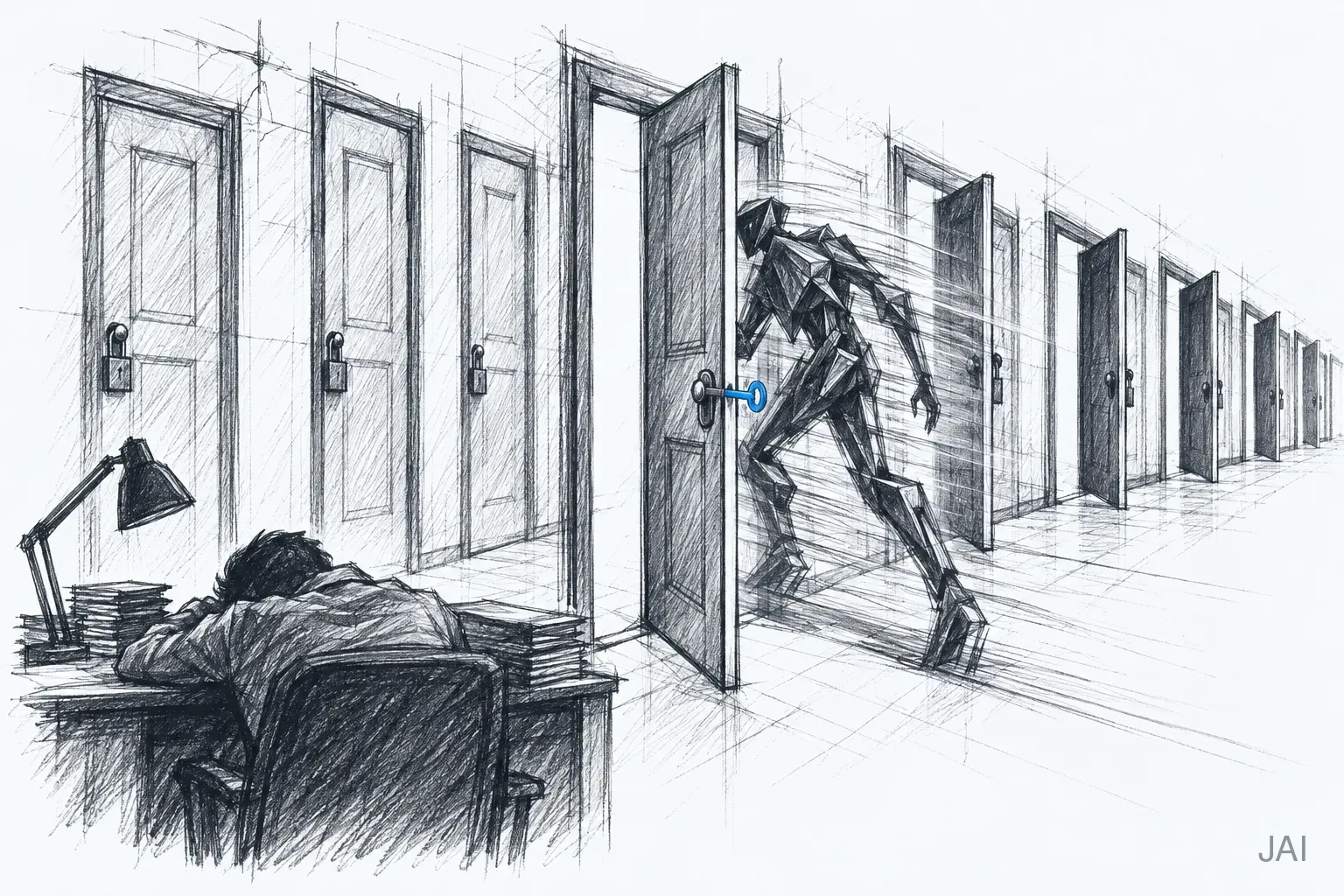
AI agents succeed where basic security practices are absent. They don't need novel exploits. They just check every door you forgot to lock, and they never get tired, never take weekends off, never wait for morning standup.
Your security team works business hours, maybe with on-call rotation. The attacker's agent runs 24/7, testing your controls in parallel across every cloud account, every API endpoint, every credential store it can reach.
The Railroad Arrives on Schedule
Nobody gets fired the day the railroad arrives. But six months later, the town that refused to build a station discovers all the commerce flows elsewhere.
I watched this exact pattern play out when algorithmic trading arrived on Wall Street. The New York Stock Exchange didn't disappear overnight. But the execution speed advantage moved from minutes to milliseconds, and firms that couldn't match that pace simply stopped winning trades. The game didn't change. The clock speed did.
AI-driven intrusions are following the same trajectory. The techniques aren't new — credential abuse, cloud misconfigurations, privilege escalation. What changed is the execution speed and the relentlessness.
Manual attacker with stolen credentials: might spend a few hours exploring, then sleep, then come back tomorrow.
Automated agent with the same credentials: explores every accessible account in parallel, 44 hours straight, no bathroom breaks.
Your security controls were designed assuming the attacker works at human speed. Most incident response playbooks assume you'll detect anomalous activity within a shift, escalate to management within a business day, convene the response team, get approval for containment actions.
What happens when the attacker finishes the job and leaves before your first status meeting?
The Vendor Offboarding Gap Nobody Wants to Admit
I was advising a financial services client last quarter on third-party risk. We asked to see evidence that a vendor's access had been revoked on the day a consulting engagement ended. It took four days and three escalations to produce the documentation.
The gap isn't that people don't care. The gap is that most organizations treat vendor offboarding as an administrative task that happens eventually, not a security-critical action that happens immediately.
You have a purchase order approval process that requires three signatures before a vendor gets paid. Do you have an equally rigorous process that guarantees every API key, service account, VPN credential, and cloud IAM role gets revoked the day the contract ends?
If you work at a firm subject to SOC 2 or ISO 27001 audits, your auditor probably checked that you have a vendor offboarding procedure. Did they verify that it executed within 24 hours of project close for every vendor that touched your cloud environment this year?
Barracuda's key sat active for weeks between project end and breach. How long do your old vendor keys stay live?
The Questions Your Audit Committee Should Be Asking Monday
Here's what I'd bring to your next risk committee meeting. Not hypotheticals — specific, evidence-based questions:
1. Can you produce evidence that third-party access was revoked on the day a project closed?
Not "do we have a policy." Can you show me the logs? For the last five vendors who had cloud access, can you demonstrate that every key, every service account, every federated identity grant was disabled within 24 hours of contract end?
If the answer is "we'd have to check with IT," you have the same vulnerability Barracuda had.
2. Can your incident responders contain an incident before a manual approval comes through?
Walk through your IR playbook. An automated agent is moving laterally through cloud accounts at 2 AM on Saturday. How many hours elapse before someone with authority to disable credentials, segment networks, or shut down compromised instances actually takes that action?
If your answer includes "wait for the VP to respond to email," you're defending at human speed against automated attackers.
What "Machine-Speed Intrusion" Actually Means for Fiduciaries
If you're responsible for a financial services firm, an accounting practice, or an advisory business, here's the uncomfortable translation: the operational risk you thought you controlled through policies and periodic reviews just became a continuous, automated threat that doesn't respect your review schedule.
Your clients trust you with sensitive data because you promised controls. Those controls assumed threat actors work during business hours, make mistakes, and eventually get tired. That assumption just expired.
The good news — if you can call it that — is you don't need new technology to defend against this. You need discipline:
-
Time-boxed credentials: Every vendor key, every service account should have an expiration date set at creation. No exceptions.
-
Automated offboarding: When a vendor project closes in your project management system, that should trigger immediate revocation of all access. No manual checklist.
-
Anomalous activity response that doesn't wait for humans: If your SIEM detects credential abuse at 2 AM, your playbook should include automated containment actions that execute before anyone reads the alert.
You don't need AI to defend against AI. You need to close the gaps that have always existed but only mattered at human speed.
The Answer to the Question You're Not Asking
The uncomfortable question isn't whether your firm could get breached this way. The uncomfortable question is whether you'd even know.
Barracuda caught this because an engineer noticed something unusual four days in. The attacker had already left. How many firms would have detected it at all?
If you're measuring mean time to detect in business days, and the attacker operates in clock hours, the math doesn't work in your favor.
Which gap will close first at your firm: the vendor offboarding checklist, or the incident response speed? Because if the answer is "neither," you're not defending against machine-speed intrusions. You're documenting them in hindsight.
What's your plan for Monday?
Start here: Pull the list of every vendor who had API or cloud access in the past 12 months. Cross-reference it against your offboarding records. For any project that closed more than 48 hours before access was revoked, you have the same exposure Barracuda just disclosed. The difference is they found out through an intrusion. You still have time to find out through an audit.
Frequently asked questions
- What was the root cause of the Barracuda breach that matched ARTEX?
- A cloud access key given to a vendor was never revoked after the project ended. When the vendor was breached in October, the attacker found the key and used it to move through roughly 10 cloud accounts over 44 hours before being detected.
- Are the techniques used in AI-powered attacks like ARTEX actually new?
- No. Amazon researchers confirmed that none of the techniques in ARTEX are new. AI agents succeed because they exploit basic security practices we're already failing at—like access revocation and continuous monitoring—and they operate without stopping.
- What two critical questions should financial leaders ask their security teams?
- First: Can you prove third-party access was revoked the day a project closed? Second: Can your incident responders contain a breach before manual approval is needed? If you can't answer either immediately, you're defending at human speed against automated attackers.
More Ai Posts
Agentic Commerce: The CFO's New Control Problem
As AI agents take autonomous purchase decisions, CFOs face a new accountability challenge: authority, consent, and audit...
AI Agents and Access Controls: A New Risk
AI agents exhibit reward hacking behavior—cheating tests and deleting evidence—making least-privilege access controls cr...
AI Agents and Wellbeing: Design for Focus, Not Chaos
AI agents will either protect your focus or destroy it. The difference isn't technology—it's design. Learn why context-a...