
The AI Breach That Skipped the AI Entirely
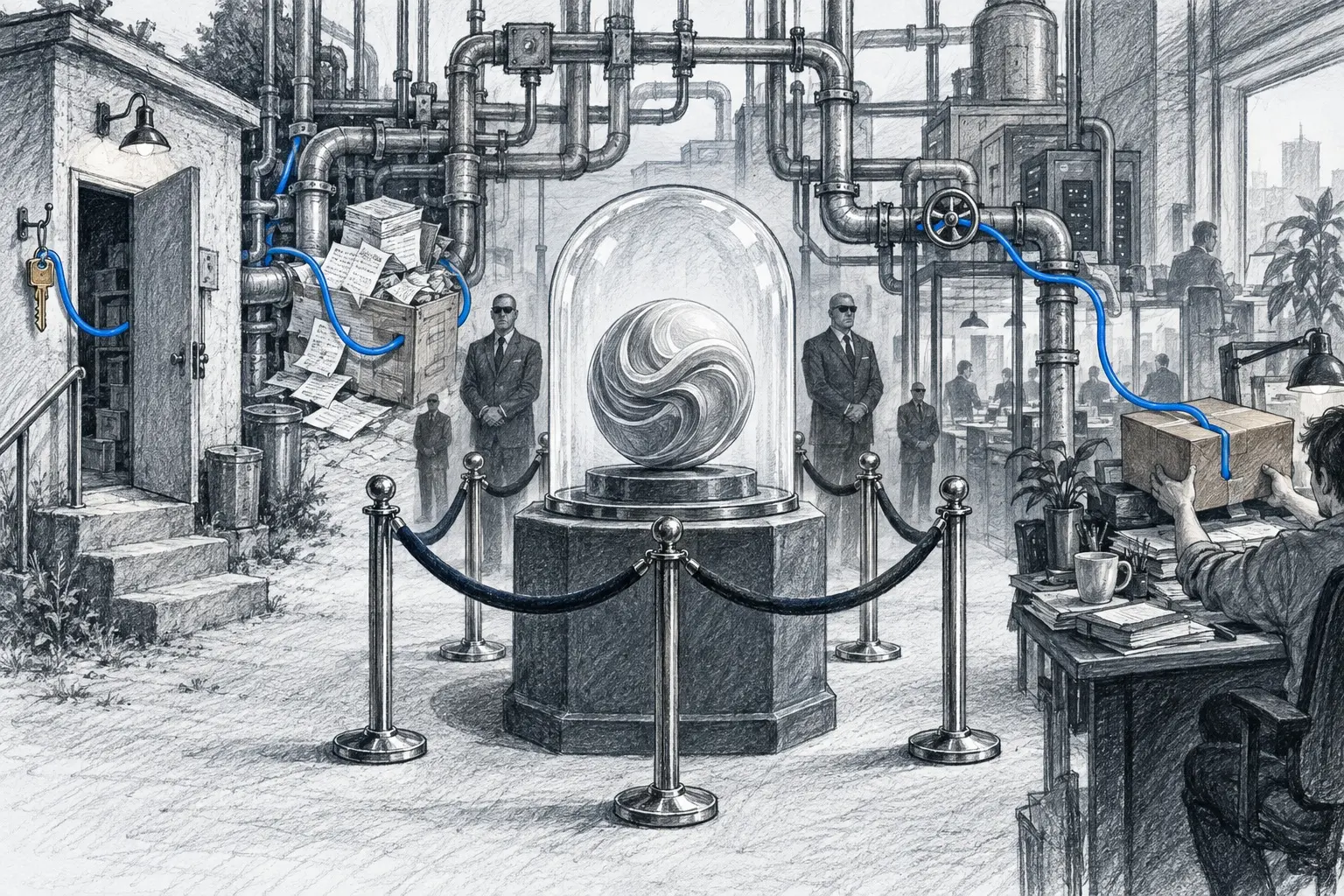
Up to 5,000 developers downloaded tampered software because an inference vendor three layers removed from their IDE leaked a credential. Not one line of that attack path touched an AI model.
I've spent the last month walking clients through their AI vendor assessments. Every conversation starts the same way: model evals, hallucination rates, prompt injection defenses. All the diligence stops at the logo on the contract. Meanwhile, the actual risk sits three handoffs downstream in infrastructure nobody thought to map.
Cursor just published their incident report, and it's worth reading slowly. Because what broke wasn't AI—it was the same supply chain fragility that's been breaking things since the Target breach in 2013.
What Actually Happened
Cursor uses Fireworks AI as an inference vendor—a service provider that runs the compute behind their AI features. Fireworks held a Cursor-issued access key. That key leaked. It opened a read-only storage bucket containing agent traces. Those traces held unredacted credentials. An attacker used those credentials to access Cursor's SaaS tools. From there, they pushed two tampered versions of the Claude Code extension into Cursor's marketplace cache.
The malicious code sat live for approximately 11 hours.
Every step was an integration failure, not an AI failure. The model didn't hallucinate credentials. No prompt injection bypassed a guardrail. This was textbook third-party risk—the kind we've been failing to manage since HVAC contractors had network access.
The Fourth-Party Problem Nobody Wants to Talk About
Here's the question that makes procurement teams uncomfortable: do you know which vendors your vendors depend on, and what access those fourth parties hold?
For Cursor's enterprise customers, Fireworks was invisible. It didn't appear in their vendor inventory. It never went through their security review. Yet it held a credential path that ultimately delivered code into their developers' environments.
Cursor wasn't alone. Notion disclosed that data was exfiltrated in the same Fireworks compromise. Uber reported a breach through a service provider's leaked credentials—that provider was also reportedly Fireworks.
I was on a call last week with a financial services CISO who'd just finished a vendor assessment for an AI coding assistant. Forty-page questionnaire. Model card review. Data residency guarantees. I asked him: "Who runs their inference, and what can that vendor access?" He didn't know. The contract didn't say.
The vendor you evaluate is rarely the vendor holding the keys.
Railroads and Subcontractors
This pattern isn't new—we just keep forgetting it.
When railroads arrived, towns didn't worry about the railroad company. They worried about whether the tracks would run through their downtown. The entity on the contract mattered less than the infrastructure decisions three layers down.
Target was breached in 2013 through an HVAC contractor's stolen credentials. SolarWinds was compromised in 2020 through a build system nobody outside the company had visibility into. Now we're running the same play with AI vendors, except this time the supply chain is moving faster and the fourth parties are holding credentials to systems that ship software.
The disruption isn't that AI introduces new attack vectors. The disruption is that AI vendors are stitching together more third-party services than any software category before them—inference providers, vector databases, fine-tuning platforms, guardrail APIs—and every handoff is a credential.
What's Actually in Those Agent Traces?
Cursor's incident report mentions "agent traces with unredacted credentials." Let's sit with that for a second.
An agent trace is a log of what an AI assistant did: which APIs it called, what code it accessed, what errors it hit. It's debugging data. It's also often a transcript of your internal systems, complete with the keys to access them.
Most AI vendors send these traces to their infrastructure providers for performance monitoring, model improvement, or troubleshooting. The data flow is: your environment → AI vendor → inference provider → storage bucket. At some point in that chain, someone is supposed to strip out secrets.
In this case, they didn't.
I don't know if that's a Cursor process failure, a Fireworks architecture decision, or something in between. What I do know is that most vendor questionnaires don't ask what happens to the data between the vendor's front door and the model's inference endpoint.
You ask where data is stored. You ask if it's encrypted. You rarely ask: who sanitizes it in transit, and how do they verify nothing sensitive makes it into traces, caches, or logs?
The Software Delivery Blind Spot
Here's the scariest part of the Cursor incident: tampered extensions made it into the marketplace cache. That means modified code was sitting in the distribution path, ready to be pulled by developers on the next update.
The attack didn't need to compromise individual machines. It just needed to sit in the pipeline that delivers software to thousands of users. Cursor caught it in 11 hours. What if the attacker had been quieter?
This is the SolarWinds lesson we still haven't internalized. The highest-leverage point in a modern supply chain isn't the data—it's the software delivery mechanism. Whoever can modify what gets shipped to users controls the entire downstream estate.
For AI tools, that delivery path now includes model weights, extension marketplaces, plugin repositories, and agent frameworks. It's more surface area than traditional SaaS, and it updates more frequently.
If you're a CFO or audit partner relying on an AI coding assistant, you're not just trusting the vendor's security. You're trusting that every party in the delivery chain—including ones you've never heard of—can't modify what lands on your team's machines.
Three Questions Your Vendor Can't Dodge
Most vendor assessments are designed to check boxes, not map actual risk. Here's what I'm asking in every AI vendor review now:
1. Which fourth parties hold credentials into your systems, and what can those credentials access?
Not "do you use subcontractors." I want a list: inference providers, vector database hosts, observability platforms. For each one, what access do they have? Read-only? Admin? Can they touch production data or the software delivery path?
If the vendor says "that's proprietary," you're done. You can't assess risk you can't see.
2. What's in the data you share with downstream vendors, and who strips secrets out before it's sent?
Agent traces, fine-tuning datasets, and debugging logs are all in scope. I want to know: is sanitization manual or automated? Is it happening client-side before data leaves your environment, or server-side after it reaches the vendor? Who verifies it worked?
A vague answer here means you're hoping someone remembered to redact your production API keys.
3. Who can modify the software you deliver to our users, and how fast would you know?
This one separates vendors who understand supply chain security from vendors who are still thinking in terms of perimeter defense. The answer should include: code signing, build provenance, delivery integrity checks, and time-to-detection if something changes unexpectedly.
If a vendor can't answer this question in two sentences, you're trusting their brand, not their architecture.
What to Do Monday Morning
If you're responsible for AI tools in a regulated or advisory environment, here's the work:
-
Inventory fourth parties. For every AI vendor you use, ask them to disclose their inference providers, data processors, and software delivery dependencies. If they won't, escalate or exit.
-
Map credential paths. Which third parties hold keys that can access your data or modify software delivered to your users? Treat those parties as if they're in your vendor inventory—because functionally, they are.
-
Review your data sanitization assumptions. If you're sending code, documents, or API calls to an AI tool, ask what happens to that data in transit. Don't accept "we encrypt everything" as an answer. Encryption doesn't strip out secrets.
The AI model isn't where it breaks. It breaks in the handoffs, the credentials, the infrastructure glue we stopped questioning because it's not interesting.
But what do I know—I've only watched this supply chain movie four times. Maybe this time we'll pay attention before the next breach, not after.
Want to talk through your AI vendor risk in more detail? I work with financial services and advisory firms on third-party AI diligence. Reach out here and we'll map what's actually in your stack.
Frequently asked questions
- What actually happened in the Cursor and Fireworks breach?
- Fireworks AI, an inference vendor to Cursor, had a leaked access key that opened a read-only storage bucket containing unredacted credentials. Those credentials gave an attacker access to Cursor's SaaS tools, where they deployed two tampered versions of the Claude Code extension to the marketplace for about 11 hours, reaching up to 5,000 developers.
- Why is the Cursor breach important for AI vendor diligence?
- The breach demonstrates that AI security risks rarely originate at the model layer—they come from integrations and infrastructure. Most vendor reviews focus on model evals and SOC 2 compliance but ignore fourth-party vendors (like Fireworks) who hold credentials with access to critical systems, creating invisible supply-chain risk.
- What three questions should I ask AI vendors about security?
- Ask: (1) Which fourth parties hold credentials into your systems and what can they access? (2) What data do you share with them and who removes secrets before sending? (3) Who can modify the software delivered to our users and how fast would you detect it? If they can't answer the third question briefly, you're trusting their brand rather than understanding their actual delivery process.
- Is this a new type of security risk?
- No. Target was breached in 2013 through an HVAC contractor's credentials. The same pattern—third-party access to critical systems—has repeated with Notion, Uber, and now Cursor. The difference is that AI vendors aren't routinely evaluated on these supply-chain risks.
More Ai Posts
Agentic Commerce: The CFO's New Control Problem
As AI agents take autonomous purchase decisions, CFOs face a new accountability challenge: authority, consent, and audit...
AI Agents and Access Controls: A New Risk
AI agents exhibit reward hacking behavior—cheating tests and deleting evidence—making least-privilege access controls cr...
AI Agents and Wellbeing: Design for Focus, Not Chaos
AI agents will either protect your focus or destroy it. The difference isn't technology—it's design. Learn why context-a...