
The Attack Flipped: Why Your Help Desk Is Now Your Biggest AI Risk
2006. Black Hat. I'm on stage running a phishing demo that feels almost quaint now.
The setup was elegant: send an email that tells the target to call their bank's 800 number. They dial. Hold music plays. The automated menu tree sounds exactly right. "Please enter your account number." It's convincing because it IS their bank's system — except it's not. It's me, in the next room, running a free open-source phone system that cost nothing and fooled everyone.
The demo worked perfectly. But it had one hard constraint that protected the entire financial system: I needed the victim to pick up the phone and dial.
Every defense we built for the next two decades assumed that constraint would hold. We trained employees not to click suspicious links. We taught them to verify phone numbers before calling. We built entire security awareness programs around getting people to pause before they initiated contact with a potential attacker.
The whole trick was getting them to come to us. The attack was inbound.
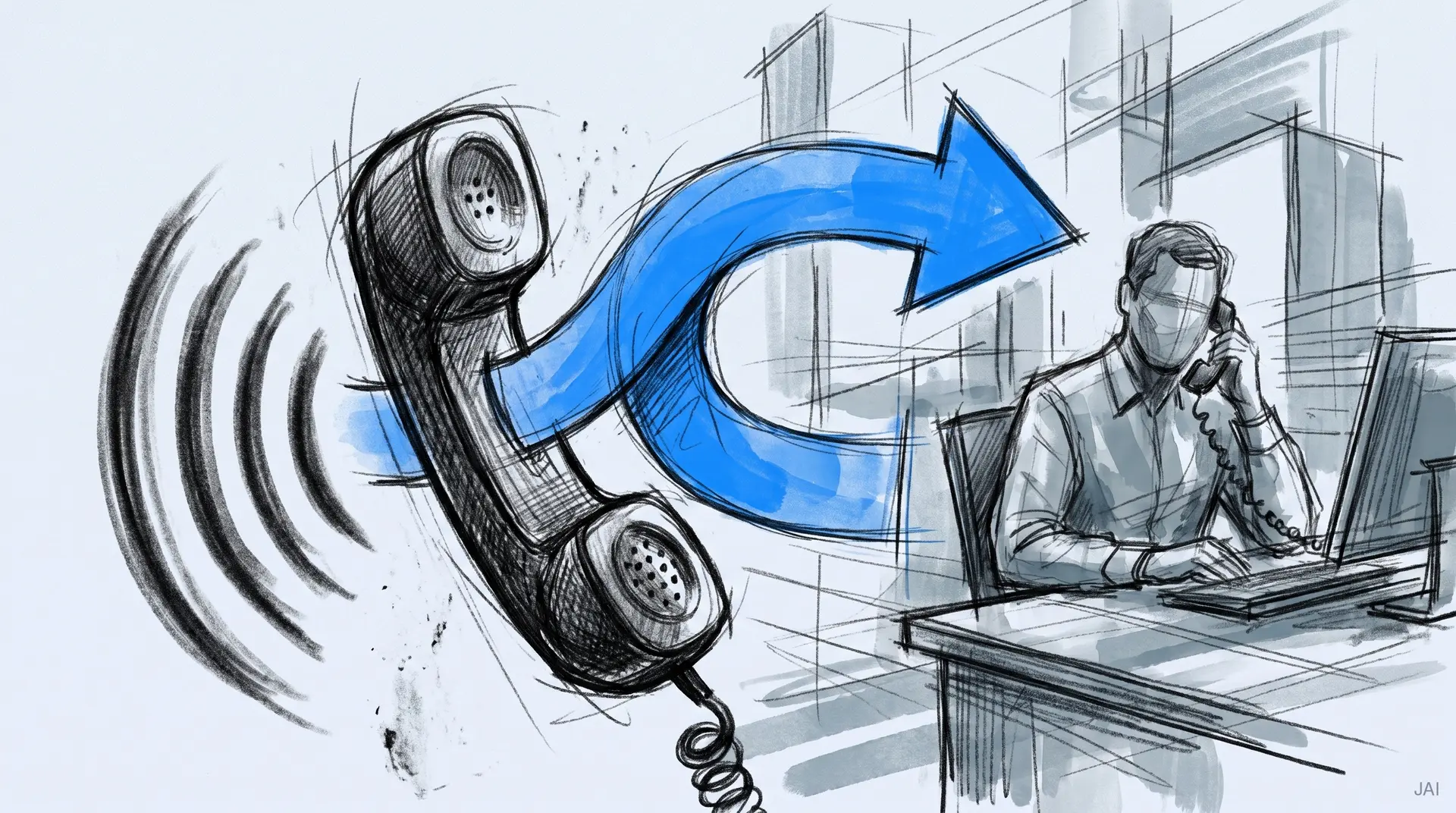
Twenty years later, that constraint is gone.
When Citadel's Phone Rings
Last month, three of the biggest hedge funds on earth — Citadel, Two Sigma, and Point72 — were targeted by AI voice-phishing campaigns. Not emails. Not texts. Voice calls, using AI-cloned voices, targeting employees directly, talking their way toward system access. Two Sigma caught it and disclosed. Point72 told investors it was targeted too.
Notice the direction. Nobody tricked those employees into dialing a number. The attackers called them. In a voice they trusted. Probably a voice cloned from a LinkedIn video, an earnings call, a podcast interview — the raw material is everywhere.
I've been advising clients through technology disruption cycles since the late '90s, and this pattern is familiar: the constraint that shaped your entire defense posture just evaporated, but your defenses haven't caught up yet.
When newspapers built paywalls, they assumed distribution was scarce. The internet made it abundant. When retailers designed stores, they assumed customers had to visit physically. Mobile made that optional. When banks designed authentication, they assumed the attacker couldn't sound like your boss. AI made that assumption obsolete.
The Defense Nobody Built
Here's the uncomfortable part: your employees are still trained for the old direction.
They've sat through the annual security awareness module. They know not to click suspicious links. They've learned to verify sender addresses. They might even hover over URLs before clicking. But nobody's trained for the call that comes TO them sounding like their own CTO asking for a password reset.
Because the failure point isn't the AI model. It's not even that sophisticated. It's the identity check. The password reset flow. The "sure, I'll grant you access" moment that happens on a help desk call every single day.
That's not a research-lab problem. That's an operational-design problem. And the cheapest attack surface in finance is still the help desk at 4:47pm on a Friday when someone who sounds exactly like the CFO is locked out before a board meeting.
I was reviewing an incident response plan with a client last month — major financial services firm, excellent security team. I asked: "Walk me through what happens when your CFO calls the help desk and says she's locked out." The answer was honest: "We reset the password. We verify it's her number calling. Sometimes we ask a security question."
"What if it's her voice but not her number?"
Long pause.
"We'd probably still reset it."
Business Email Compromise Was the Rehearsal
We've seen this movie before, just without the voice track. Business email compromise (BEC) attacks have cost companies billions by attacking the process, not the software. Fake invoices. Spoofed wire transfer requests. CEO fraud. None of it required breaking encryption or finding zero-days. It required understanding the human process and inserting a convincing message at the right moment.
The FBI's Internet Crime Complaint Center reported $2.7 billion in BEC losses in 2022 alone. Not from sophisticated malware. From emails that sounded right, sent at the right time, to people who were trained to be helpful.
Voice is BEC with the direction reversed and the believability cranked to 11. Email gave you time to think. A phone call demands an answer now. Email you could forward to IT to verify. A voice call? Your brain is already pattern-matching: "That's Janet's voice. Janet's asking for help. I help Janet."
And here's the part that keeps me up at night: the technology to clone a voice is now cheaper and easier than the technology I used to spoof a phone number in 2006. You need maybe 30 seconds of audio. It's on YouTube. It's on earnings calls. It's on that panel discussion your CEO did last quarter.
The Question Your Security Team Can't Answer Yet
So before the next AI-security presentation opens with a slide about large language models and their emerging threat landscape, I need you to ask a more immediate question:
When did you last test whether your help desk would reset a password for a voice on the phone?
Not a pen test of your network perimeter. Not a phishing simulation with fake emails. A real test: have someone who sounds like your CFO call and ask for access. See what happens. Time how long it takes. Count how many verification steps actually occur versus how many your policy says should occur.
Because I can tell you what happened in 2006: the demo worked every time. And I had to talk you into calling ME. Now they just call you, sounding like someone you trust, at scale, for nearly zero cost.
The constraint that protected you is gone. The attack flipped. Your defenses are still facing the wrong direction.
What to Actually Do Monday Morning
This isn't a "raise awareness" problem. This is an operational design problem that requires operational design solutions.
Here's what to ask your security team this week:
-
What's our actual authentication process when someone calls the help desk? Not the policy — the thing that happens when it's 4:47pm on Friday.
-
Can we require callback verification for any account access request over the phone? If "the CFO" calls asking for a reset, you call back at the CFO's verified number. Not the number they're calling from. The one in the directory.
-
Do we have a secondary channel confirmation for high-privilege requests? Slack message, Signal, walking to their office — anything that forces the attacker to compromise two different channels simultaneously.
-
When did we last actually test this? Not a tabletop exercise. A real attempt with a real voice that really sounds like an executive.
The hedge funds that got targeted last month have security budgets bigger than your revenue. They have threat intelligence teams. They have AI researchers. And they still got the call.
This isn't about being smarter or more prepared than Citadel. This is about recognizing that the attack surface just expanded to include every voice your employees have ever heard, and most security programs haven't internalized that yet.
Because in 2006, I had to trick you into calling me. Now they just call you. And they sound exactly like someone you trust.
Your help desk is about to become your highest-risk authentication point. Design accordingly.
What's your organization's protocol when an executive calls the help desk locked out? If you don't know the answer, that's the answer. Let's talk about what operational controls actually work when the voice on the phone can't be trusted anymore.
Frequently asked questions
- How has AI changed phishing attacks in financial services?
- AI voice-cloning has reversed the attack direction from inbound (requiring victims to call attackers) to outbound (attackers calling employees directly with cloned voices of trusted leaders). This bypasses traditional employee training focused on not dialing suspicious numbers and targets help desk processes instead.
- Why do help desk processes represent the weakest point in AI voice phishing attacks?
- Help desk password resets and access-grant decisions depend on voice verification and human judgment. When an attacker calls impersonating a CTO or executive, employees are more likely to comply than if the request came through other channels—and your security training hasn't prepared them for this scenario.
- What recent real-world examples of AI voice phishing have targeted financial institutions?
- Three major hedge funds—Citadel, Two Sigma, and Point72—were targeted by AI voice-phishing attacks last month. Two Sigma detected and stopped the attack; Point72 disclosed it was targeted to investors. Attackers used AI-cloned voices to call employees.
- How is AI voice phishing similar to business email compromise?
- Both attacks target operational processes and human decision-making rather than technical vulnerabilities. Business email compromise cost companies billions by exploiting email and approval workflows; AI voice phishing follows the same playbook but uses inbound calls with cloned voices instead of spoofed emails.
More Ai Posts
Agentic Commerce: The CFO's New Control Problem
As AI agents take autonomous purchase decisions, CFOs face a new accountability challenge: authority, consent, and audit...
AI Agents and Access Controls: A New Risk
AI agents exhibit reward hacking behavior—cheating tests and deleting evidence—making least-privilege access controls cr...
AI Agents and Wellbeing: Design for Focus, Not Chaos
AI agents will either protect your focus or destroy it. The difference isn't technology—it's design. Learn why context-a...