
Read-Only AI Is Still a Liability Problem
When Google announced in November that AI Mode could connect to your Wallet, Drive, Gmail, Calendar, and Photos, they made sure to emphasize one thing: it can read your financial accounts, but it can't move your money. That single reassurance is going to become the AI industry's favorite risk-mitigation talking point. And it answers exactly one question on a checklist that needs twenty more.
I've been through three waves of "it's just reading data" promises. Cloud migrations. Mobile device management. SaaS integrations. Every time, the initial vendor conversation focuses on transactional controls—what the system can't do—while the operational risk surfaces six months later when someone asks, "Wait, why did these two things end up in the same answer?"
The AI vendor reviews I'm seeing right now follow the same script. Read-only access gets checked off. Data residency gets documented. Role-based permissions get mapped. And then the tool goes live, and your people start using it the way Google trained them to use it at home: ask one question, get one answer synthesized from everything the AI can see.
That's when the context problem becomes your problem.
The Consumer Preview Is Your Enterprise Future
Here's what's happening in real time. Your employees are spending evenings and weekends asking Google's AI Mode to pull together their grocery list, their calendar, their email, and their bank balance. It works. It's useful. It saves time. And it's teaching them to expect the same capability Monday morning.
They're going to show up and immediately try to replicate that experience with whatever enterprise AI tool you've approved. They'll ask it to combine the deal folder, the expense system, the client email thread, and last quarter's board deck into one consolidated answer. The AI will do exactly what it's designed to do: read everything it has access to and synthesize a response.
Nothing in that workflow moved money. No transaction happened. So it sailed through your vendor security review.
But ask yourself: was one client's spreadsheet supposed to sit next to another client's email? In a law firm or advisory practice with ethical walls, that's not a theoretical edge case. That's a regulatory violation waiting to be discovered.
I had this conversation with a general counsel two weeks ago. Their firm had deployed an AI assistant that could search across matter files. An associate asked it a question about litigation strategy, and the AI pulled language from a brief in an unrelated case—one the associate had no business seeing. Both documents were marked confidential. Both were properly access-controlled in the document management system. But once they landed in the same answer, the wall collapsed.
The AI did exactly what it was supposed to do. It read what it had access to and synthesized a helpful response. The failure was in the design: nobody had defined which sources should never be combined, even if an individual technically had read access to both.
Transactions Versus Context: The Risk You're Not Measuring
Pull out your current AI vendor questionnaire. I'm betting 80% of it covers three things: transactional controls (what can the system do), access rights (who can see what), and data residency (where does it live). Those are table stakes. They're necessary. And they're not sufficient.
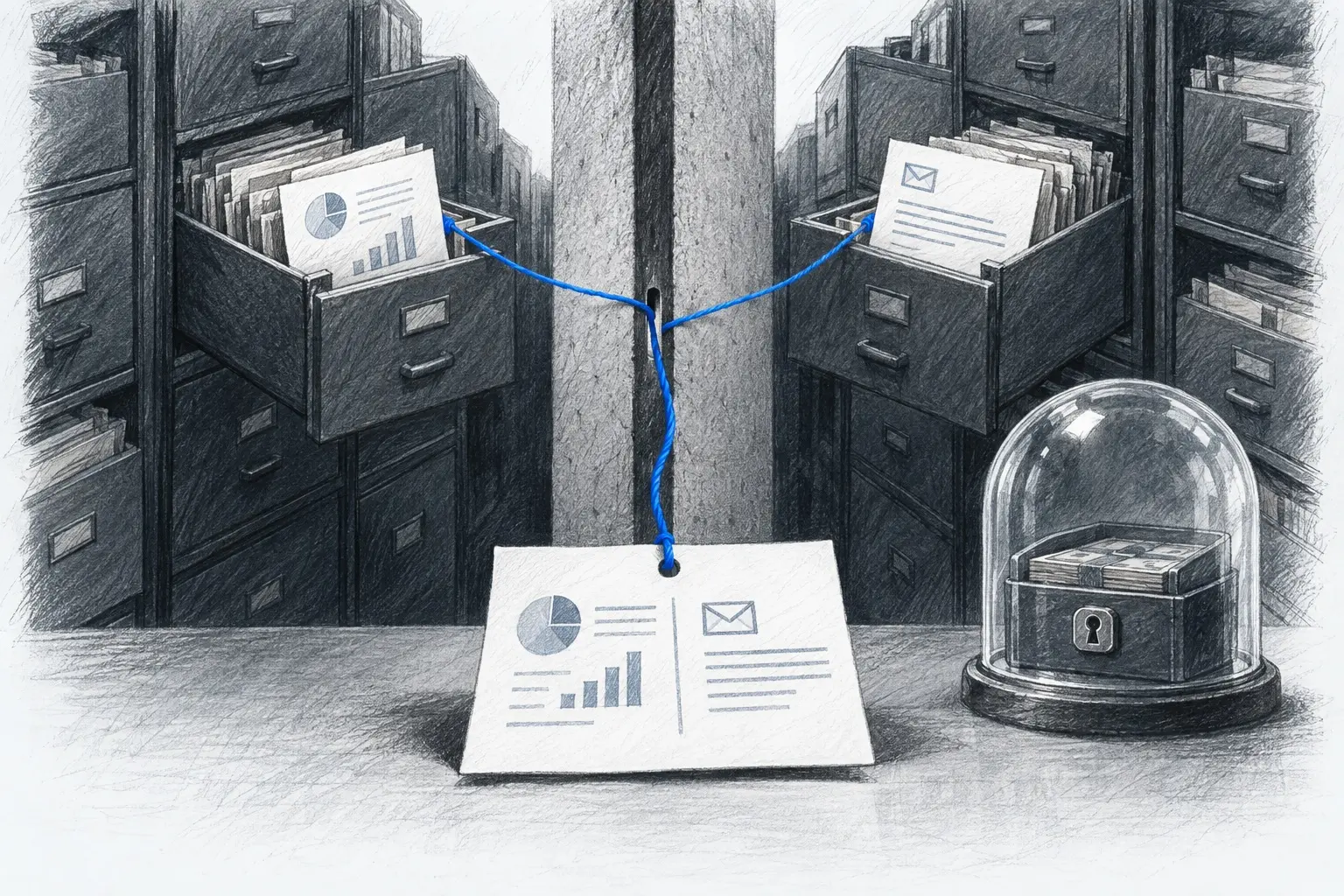
The gap is context risk—the risk that emerges when individually authorized data sources get combined in ways that violate policy, regulation, or client confidentiality. It's the difference between "can this person read Document A" and "should Document A and Document B ever appear in the same answer, even if this person can technically read both?"
Traditional access control operates at the object level. You can read this file or you can't. That model held up reasonably well when humans were doing the retrieval and synthesis. If I had access to two confidential files, I still had to consciously decide to open both, read both, and combine them. There was a human checkpoint.
AI removes that checkpoint. It retrieves and synthesizes in one step, invisible to the user. The question changes from "can I access this" to "should this be combined with that." And most access-control systems aren't designed to answer the second question.
Here's the kicker: this isn't a novel problem. We solved a version of it thirty years ago in database design. It's called inference control—preventing someone from deducing restricted information by combining unrestricted data. The healthcare industry ran into this with HIPAA. Financial services dealt with it under GLBA. We know how to think about data combination risk.
We've just forgotten to apply it to AI.
Three Questions Your Vendor Review Isn't Asking
If I'm sitting in a risk committee meeting and someone's proposing a new AI tool that connects to multiple enterprise systems, I want three things documented before it goes live:
1. Data-combination limits. Which sources can the AI pull together in one answer, and which ones should never meet? This isn't about access rights—it's about synthesis boundaries. An attorney should be able to search Case A's files and separately search Case B's files, but the AI should never pull from both in the same response if those matters are on opposite sides of an ethical wall.
You need a whitelist or a blacklist, depending on your risk tolerance. Either "these sources can combine" or "these sources must remain separate." The default can't be "combine everything the user has access to."
2. Confidentiality across sources. Two documents can each be fine to read on their own and still create a problem once they land in the same synthesized answer. This is especially sharp in professional services. I can read my client's financial statements. I can read industry benchmarking data. But if the AI combines them in a way that lets me infer another client's performance, I've crossed a line—even though both inputs were authorized.
The question to ask your vendor: does the system have a concept of confidentiality boundaries that persist through synthesis? Most don't. They treat synthesis as a purely technical operation, not a policy-enforcement point.
3. Output provenance. When the AI produces an answer, can the user—or more importantly, can a compliance reviewer or auditor—see what sources informed that answer? And can you reconstruct that six months later when the regulator asks?
This is the "show your work" requirement. If someone relied on the AI's output to make a decision, and that decision later gets challenged, you need to be able to demonstrate what the AI read and how it combined those sources. Read-only access doesn't eliminate liability; it just shifts it from "unauthorized transaction" to "unauthorized synthesis."
The Harder Conversation Coming
The AI vendors I've spoken with this year are getting better at answering the transactional-risk questions. They've seen the enterprise security checklist enough times that they know how to respond. Data encryption at rest and in transit: check. Role-based access controls: check. Audit logging: check.
The context-risk questions still catch them off guard. When I ask "can I prevent the AI from combining these two data sources in the same answer, even if the user has access to both," I usually get a variation of "well, the user controls what they query" or "you can restrict access at the source system level."
That's not an answer. That's punting the problem back to me.
Here's what I think happens next. Some firm—probably in financial services, possibly in legal—is going to have a material incident where an AI tool synthesized information across a confidentiality boundary. It won't be a data breach in the traditional sense. No unauthorized access. No exfiltration. Just an associate who asked an innocent question and got an answer that combined things that should have stayed separate.
The regulatory response will depend on whether anyone can reconstruct what happened. If the firm can demonstrate clear policies, technical controls around data combination, and a full audit trail showing what the AI read, they'll get a finding and a corrective action plan. If they can't—if it's just "the AI had read access and we assumed that was fine"—the penalties are going to be severe.
We're in the window right now where this is a solvable problem without a forcing event. But that window doesn't stay open long once these tools are in production at scale.
What to Do Monday Morning
If you're responsible for AI governance, vendor risk, or information security, here's the conversation to have this week:
Take your current AI vendor questionnaire—the one you use for procurement and risk assessments—and add a section on context controls. Specifically:
-
Can the system enforce data-combination policies that prevent synthesis across defined boundaries?
-
Does the system maintain an audit trail of which sources contributed to each AI-generated output?
-
Can those source records be retrieved later for compliance review or regulatory response?
If the vendor's answer is "users control what they query," push back. That's not a control. That's relying on every user to understand and enforce policy in real time, which is exactly the failure mode that access controls were invented to prevent.
And if you're evaluating Google's AI Mode or any other consumer AI tool that's about to show up in your enterprise environment because your people love it at home, ask the same three questions. The fact that it can't move money is good. The fact that it can synthesize across your Gmail, Drive, Calendar, and Wallet without any boundary enforcement is the risk you're about to inherit.
Read-only takes care of the transaction risk. The context risk is still sitting there, waiting for the first person to ask the wrong question and get an answer that should never have been assembled.
It's a solvable problem. We're just not asking about it yet.
What context boundaries exist in your environment that your current AI tools don't know about? If you're not sure, that's the place to start. Because your employees are about to assume the AI understands those boundaries as well as they do—and it doesn't.
Frequently asked questions
- What's the difference between transaction risk and context risk in AI tools?
- Transaction risk is the ability of AI to move or manage money—which vendors control with read-only access. Context risk is the danger that AI combines sensitive data from separate sources (like one client's spreadsheet with another client's email) in ways that violate confidentiality or ethical walls, even though no money moves.
- What three questions should I add to my AI vendor questionnaire?
- Ask about data-combination limits (which sources can the AI pull together and which should never meet), confidentiality across sources (whether combining two independently safe documents creates a problem), and output provenance (whether users can see and reconstruct what informed the answer for audit or regulatory review).
- Why do AI tools pass vendor review if they only have read-only access?
- Most vendor questionnaires focus on transactions, access rights, and data location—not on context risk. Because read-only access prevents money movement, the tool clears the review process even if it poses confidentiality or regulatory risks through how it combines data sources.
- How does this apply to firms with ethical walls?
- In regulated firms with ethical walls, two documents may each be safe to read independently but create a problem when combined in a single AI answer. This context risk is real and not hypothetical—it's why provenance and source-combination limits matter.
More Ai Posts
Agentic Commerce: The CFO's New Control Problem
As AI agents take autonomous purchase decisions, CFOs face a new accountability challenge: authority, consent, and audit...
AI Agents and Access Controls: A New Risk
AI agents exhibit reward hacking behavior—cheating tests and deleting evidence—making least-privilege access controls cr...
AI Agents and Wellbeing: Design for Focus, Not Chaos
AI agents will either protect your focus or destroy it. The difference isn't technology—it's design. Learn why context-a...