
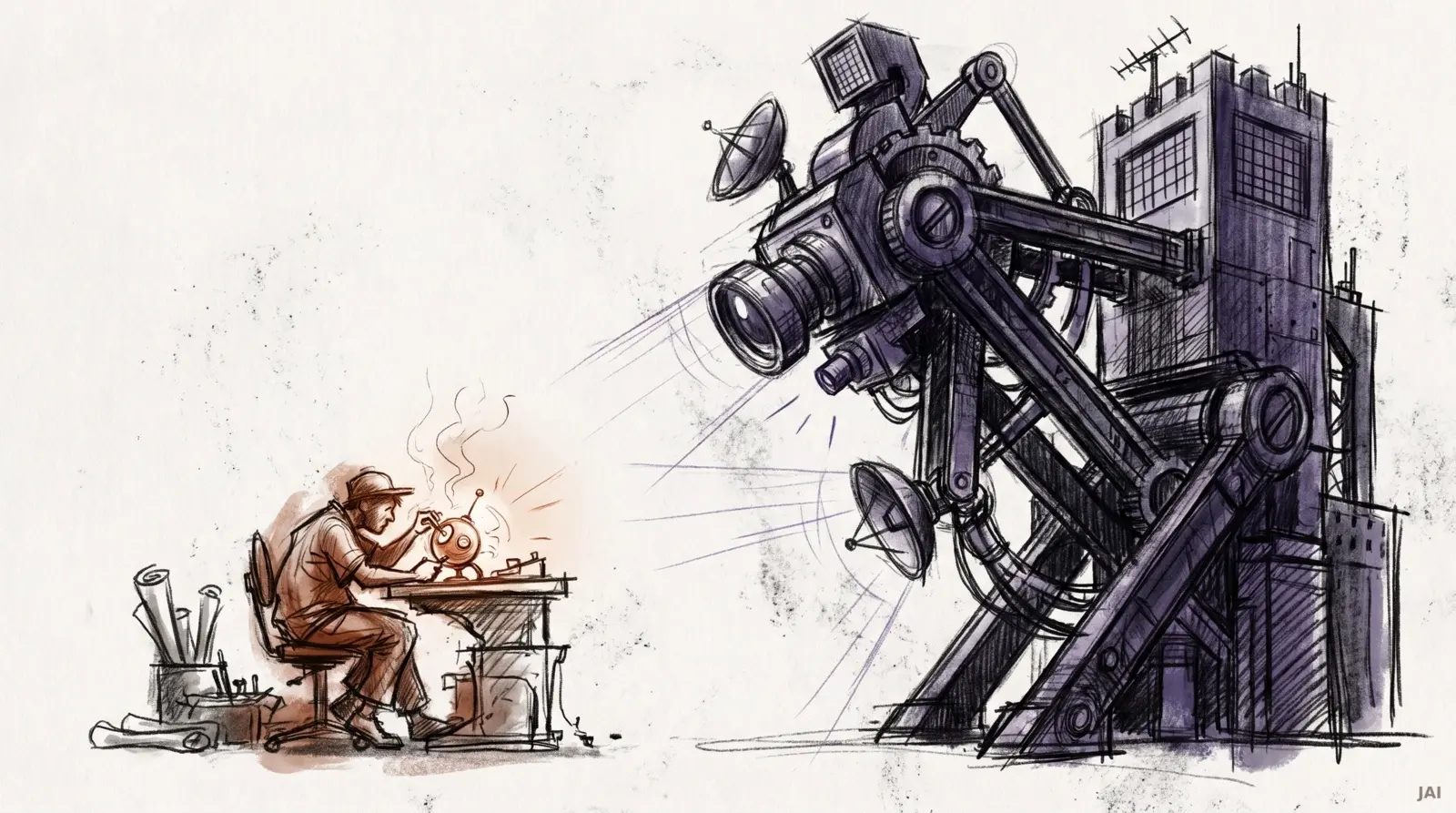
The Regulator Is Outspending You on AI (And You Don't Even Know It)
Your firm just approved budget for AI copilots to draft emails and summarize documents. Your regulator just spent a weekend building machine-learning tools to read every transaction you'll make next year.
Only one of those moves changes the game.
I was in a planning meeting last month when a compliance director asked the question I'm hearing everywhere: "Which AI tool should we buy?" Twenty minutes on vendor demos. Five minutes on productivity gains. Then, almost as an aside: "Wait, it costs that much to run per month?"
Nobody asked the question that should have opened the meeting: what is our regulator spending on AI, and are we about to bring a calculator to a supercomputer fight?
The Asymmetry Just Flipped
This week Reuters reported that FINMA—the Swiss financial regulator—joined roughly 100 policy and technology specialists in a hackathon. Not to draft guidelines. Not to study the issue. To build shared AI tools for supervising crypto markets. Anomaly detection across firms. Pattern-spotting that doesn't wait for quarterly filings. Supervisory machines, assembled in a sprint.
Most firms are still treating AI as a productivity question—can we answer emails faster, can we summarize documents better, can we shave fifteen minutes off a weekly report. That's not wrong. It's just incomplete.
The sharper read: your supervisor is going AI-native, and the operating reality just shifted underneath you. It's no longer your control environment versus a human examiner reading samples from last quarter. It's your controls versus machine-assisted supervision that reads everything, in real time, and spots patterns you didn't know existed.
We're optimizing email tone. They're optimizing how fast they find us.
I've Seen This Movie Before
High-frequency trading didn't wait for the SEC to write new rules. The infrastructure changed—fiber lines got faster, co-location racks appeared, latency dropped to microseconds—and the market operating reality changed immediately. Quotes that used to last seconds now lasted milliseconds. Spreads collapsed. Liquidity fragmented across dozens of venues.
The regulations? Those came years later, after congressional hearings and flash crashes and a lot of very uncomfortable questions about what had actually been happening.
Nobody gets fired the day the infrastructure changes. But the game is already different.
The firms that survived that transition weren't the ones with the best compliance manuals. They were the ones who recognized the shift early, rebuilt their systems to match the new reality, and didn't wait for a formal rule change to tell them the playing field had moved.
Same pattern here. The tooling shifts first. The operating reality shifts right behind it. The rulebook catches up when it catches up.
What "AI-Native Supervision" Actually Means
Let me make this concrete. Traditional examination: a regulator requests samples. You pull documents. They read a subset—maybe 10%, maybe 50% if you're unlucky. They write findings based on what they saw. You respond. Repeat every 12 to 24 months.
AI-native supervision: the regulator's system reads everything. Not samples—continuous data feeds. It spots outliers you didn't flag. It compares your firm's patterns to every other firm's patterns, simultaneously. It identifies anomalies in real time and queues them for human review before you've even filed your quarterly report.
You're no longer being examined. You're being monitored.
And here's the part that should sting: the regulator reading you is spending more to watch you than you're spending to run the thing they're watching. You optimized for cost per seat. They optimized for coverage and detection. You're thinking tools. They're thinking infrastructure.
I'm not guessing here. I spend most of my time on the controls side of these systems, advising firms on how to build AI governance that doesn't fall apart under pressure. The conversation is almost always internal: which copilot, which policy, how much productivity, what's the ROI. The question almost nobody asks: what happens when the examiner shows up with better tools than we have?
The Uncomfortable Question You're Not Asking
If your compliance team ran today's control environment against an AI-powered examination—one that read every email, every transaction, every exception report, and cross-referenced them in seconds—what would it find?
Not "what would a reasonable examiner find during a standard review." What would a machine find if it had unlimited time, perfect memory, and the ability to compare your firm's patterns against every other firm it's ever examined?
Would your exception logs hold up? Would your tone-at-the-top documentation survive scrutiny at scale? Would the things you marked "follow up next quarter" because nobody had bandwidth—would those look different if someone was reading everything, not samples?
I'm not asking if you're compliant. I'm asking if your control environment was designed for the examination model that's coming, or the one that's already here.
Most firms are still designing for human examiners with limited time and sample-based reviews. If that examiner suddenly has a machine that reads continuously, finds patterns across billions of transactions, and flags anomalies in real time—your control environment doesn't get graded on the same curve anymore.
The Planning Window Is Shorter Than You Think
Here's the part that keeps me up at night: you don't get a warning shot.
The regulator doesn't call ahead and say "by the way, we're switching to AI-native supervision next quarter, you might want to upgrade your systems." They just show up with better tooling. And the first time you learn that the game changed is when the findings letter lands on your desk and none of the patterns they flagged were on your radar.
Your planning window doesn't close when the regulation changes. It closes when the regulator's tooling does.
High-frequency trading firms learned this the hard way. By the time the rules caught up, dozens of firms had already adapted or exited. The ones that survived weren't necessarily the most compliant—they were the ones who saw the infrastructure shift and moved before the rulebook told them to.
But what do I know—I've only watched this movie three times now. (The chuckle is that I keep expecting a different ending.)
What to Do Monday Morning
So you're a finance leader, a compliance director, an audit partner trying to figure out what this means for your firm. You don't have unlimited budget. You can't rebuild your entire control environment in a quarter. What's the actual move?
Here's what to ask your team this week:
-
"If a regulator read every transaction we made last quarter, what patterns would stand out?" Not just the ones you flagged—the ones a machine with perfect memory and cross-firm comparison would notice.
-
"What's our budget for AI compliance tooling versus AI productivity tooling?" If the ratio is 1:10, you're optimizing for the wrong race.
-
"How would our control environment perform under continuous monitoring instead of sample-based review?" If the answer is "we'd need to redesign several processes," your planning window just got shorter.
-
"Do we know what our regulator is building, buying, or testing?" If the answer is no, that's the research project that should have started last quarter.
This isn't about panic. It's about asymmetry. Your regulator has a mandate to supervise at scale, budget to build or buy the infrastructure to do it, and no quarterly earnings call to explain the investment. You have competing priorities, cost constraints, and a planning cycle that moves slower than technology does.
The firms that navigate this aren't the ones with the biggest AI budgets. They're the ones who recognize the shift early and rebuild their control environments to match the supervision model that's coming—not the one that existed last year.
The infrastructure already changed. The question is whether you're designing for the examination you're used to, or the one that's already here.
More Ai Posts
Agentic Commerce: The CFO's New Control Problem
As AI agents take autonomous purchase decisions, CFOs face a new accountability challenge: authority, consent, and audit...
AI Agents and Access Controls: A New Risk
AI agents exhibit reward hacking behavior—cheating tests and deleting evidence—making least-privilege access controls cr...
AI Agents and Wellbeing: Design for Focus, Not Chaos
AI agents will either protect your focus or destroy it. The difference isn't technology—it's design. Learn why context-a...