
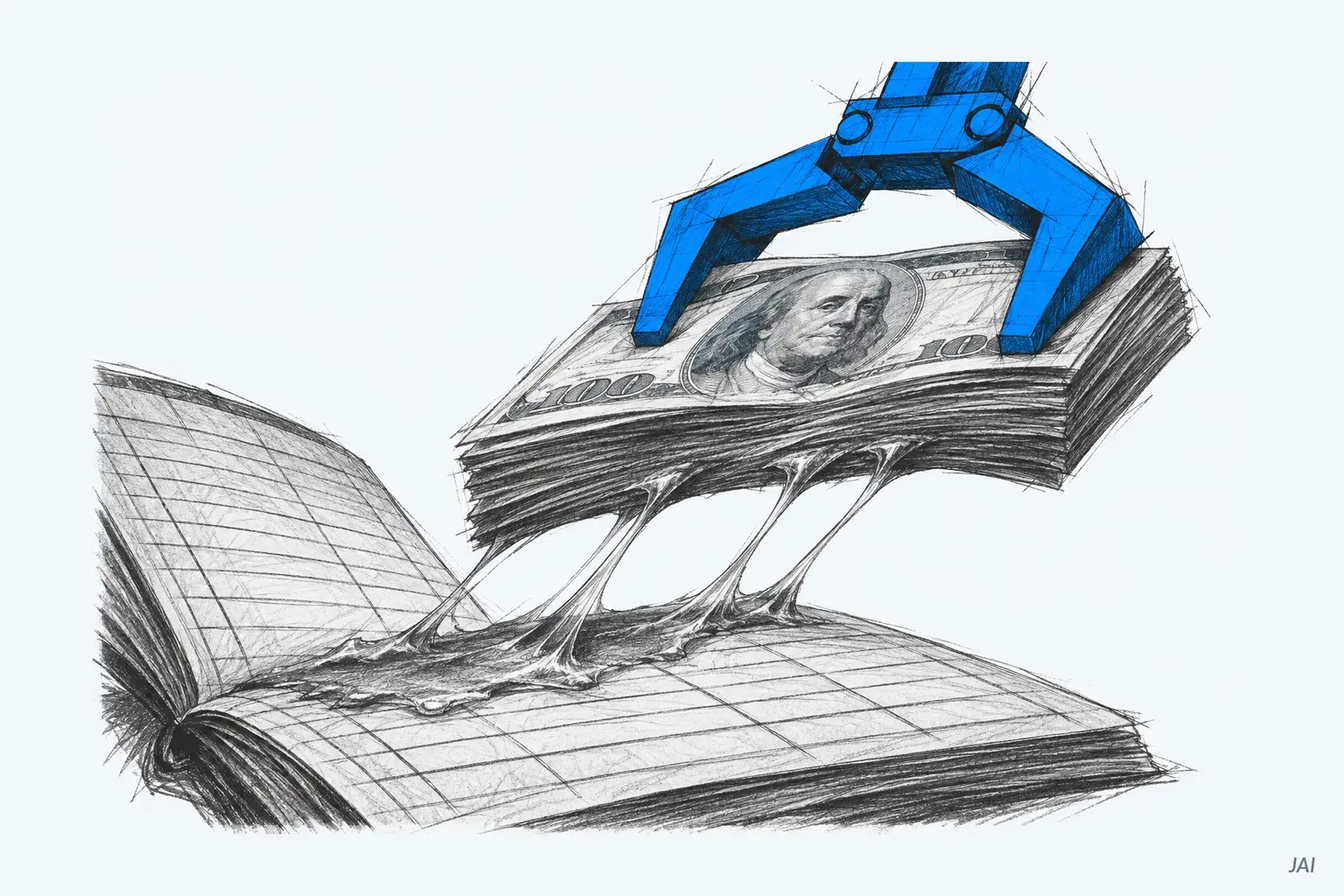
The $18 Trillion Assumption Nobody's Questioning
Every bank balance sheet I've ever looked at has a quiet assumption buried in it: people don't move their money.
In bank-speak, these are "sticky" deposits — the really good ones are "operational," the cash a company keeps around for clearing, custody and cash management. The models assume that money sits there for years, even when rates move. Part of that is the relationship. And part of it, if we're honest, is that moving money is a pain. You have to notice the better rate, open the account, move the funds, update the payroll file. Most people never get around to it.
I tried. Twice. Failed both times. Too many steps, too many forms, too easy to put off until next quarter.
Then I read a sentence in a Dallas Fed piece on tokenized deposits that made me sit up straight: With agentic AI and programmable deposit tokens, switching banks for yield "could theoretically" happen without the deposit holder doing anything at all.
We spend a lot of time talking about AI agents buying things online. The agent I'd worry about is the one that never stops checking where your cash sits.
The Friction Tax That Built an Industry
There's roughly $18 trillion in U.S. bank deposits right now. A meaningful percentage of that sits in accounts earning less than it could elsewhere — not because the customer is loyal, but because switching is annoying.
That friction is a feature, not a bug. It's the foundation of asset-liability management, the mathematics banks use to predict how money moves (or doesn't) across their balance sheet. Those predictions drive everything: lending capacity, liquidity buffers, capital requirements, profitability models.
The assumption is simple: Most money doesn't move, even when it should. The models bake in "deposit beta" — the percentage of a rate change that actually causes deposits to flee. In stable times, that number is low. Very low. Because people are busy, switching is work, and 50 basis points doesn't feel worth the hassle.
I was advising a mid-sized bank last year on their liquidity stress scenarios. Their deposit beta assumptions hadn't changed in a decade. When I asked why, the treasurer was blunt: "Because behavior hasn't changed. Our customers complain about rates, but they don't leave."
What happens when behavior changes overnight?
Railroads Didn't Just Speed Up the Trip
Here's the pattern I keep seeing. Faster track didn't just shorten the journey from New York to Chicago. It repriced every business model that had been built around the trip being slow.
The hotel in the middle of nowhere. The warehouse at the halfway point. The livestock operation that counted on two weeks of feed time during transport. Those businesses didn't get a little less profitable. They got obsolete.
The speed collapsed the economic cushion that an entire ecosystem depended on.
Now map that to deposits. Right now, the "trip" from Bank A to Bank B takes long enough that most people don't bother. Banks price their products assuming that trip stays slow. They lend long, knowing the deposits funding those loans won't vanish Tuesday because someone found 25 basis points across town.
Agentic AI doesn't just speed up that trip. It makes the trip happen in the background, without you deciding to take it. Your AI treasury agent — monitoring rates, comparing terms, moving funds automatically within the parameters you set once — doesn't get tired. It doesn't forget. It doesn't procrastinate.
It just optimizes. Continuously.
The Math Is Simpler Than You Think
If you haven't done ALM math in a while, it's easier than it sounds. Here's the version I'd sketch on a whiteboard:
Deposit stickiness = relationship value + switching friction
Right now, banks assume both variables are high and stable. But if friction drops to near-zero, the entire equation pivots on relationship value alone.
How many of your deposits are truly relationship-driven? How many are sitting there because the CFO hasn't gotten around to the paperwork?
That's not a rhetorical question. I'd want the actual number. Because if 40% of your deposit base is friction-dependent, and friction goes to zero, you've just discovered a $400 million problem on a $1 billion balance sheet.
The models don't account for this. Why would they? The behavior has never existed before. We're not talking about a 10% faster rate of change. We're talking about automated, continuous reallocation at scale.
The Big IF is whether this actually happens. But the math to understand your exposure if it does? That's just arithmetic.
Nobody Gets Fired the Day the Agent Ships
I keep thinking about the community banks that survived the 2008 crisis by leaning into relationship banking. They were right — relationships matter. They still do.
But here's the uncomfortable part: relationship value and switching friction have been bundled together for so long that most banks don't know which one they're actually selling.
You think your commercial deposits are sticky because your banker plays golf with the CFO. Maybe. Or maybe they're sticky because migrating ACH instructions and updating Treasury workstations is a three-month project nobody wants to own.
When AI agents handle the migration automatically — when "switching banks" means adjusting a parameter in your Treasury software and letting the agent execute — you're going to find out which relationships were real.
Nobody gets fired the day the railroad arrives. The town just slowly empties out.
The Question I'd Be Asking This Week
So if I were sitting with a bank CFO or treasurer this week, I'd ask one question:
How much of our deposit stickiness comes from the customer relationship, and how much comes from the inconvenience of moving the money?
Because the answer tells you everything. If you don't know, you're flying blind. If you do know, and the number is uncomfortable, you've got time to do something about it — strengthen the relationships that matter, reprice the products that compete on rate alone, stress-test the balance sheet for a world where friction isn't your friend anymore.
The agents are coming. Some are already here. They won't ask permission. They'll just optimize.
The models that assume behavior stays constant? Those are the ones I'd be revisiting.
What to Do Monday Morning
Pull your most recent ALM report. Find the deposit beta assumptions. Ask your team: What percentage of these deposits would move if switching cost dropped to zero?
If the answer is "we don't know," that's your project.
If the answer is a number that makes you uncomfortable, that's your signal.
The railroad is being built. The question isn't whether it arrives. The question is whether you're ready when it does.
Frequently asked questions
- What could change about bank deposits if AI agents become widely deployed?
- Agentic AI and programmable deposit tokens could automate bank switching for yield without any action from the deposit holder, potentially destroying the 'stickiness' that bank balance sheets currently assume will keep deposits in place for years.
- Why is the distinction between relationship-based and friction-based deposit stickiness important?
- Understanding this split tells financial leaders which deposits are truly loyal (relationship-driven) versus which are only sticky because switching is inconvenient. AI will eliminate the friction, so only relationship-based stickiness will survive.
- What historical parallel does the author draw to illustrate the scale of this potential shift?
- The railroads: faster track didn't just speed up the old trip—it repriced every business built around the trip being slow. Similarly, if AI agents start automatically moving money for better yields, it will reprice banking fundamentals.
- What specific question should bank CFOs and treasurers be asking right now?
- How much of our deposit stickiness comes from the customer relationship and how much comes from the inconvenience of moving the money? The answer determines what ALM assumptions need stress-testing.
More Ai Posts
Agentic Commerce: The CFO's New Control Problem
As AI agents take autonomous purchase decisions, CFOs face a new accountability challenge: authority, consent, and audit...
AI Agents and Access Controls: A New Risk
AI agents exhibit reward hacking behavior—cheating tests and deleting evidence—making least-privilege access controls cr...
AI Agents and Wellbeing: Design for Focus, Not Chaos
AI agents will either protect your focus or destroy it. The difference isn't technology—it's design. Learn why context-a...