
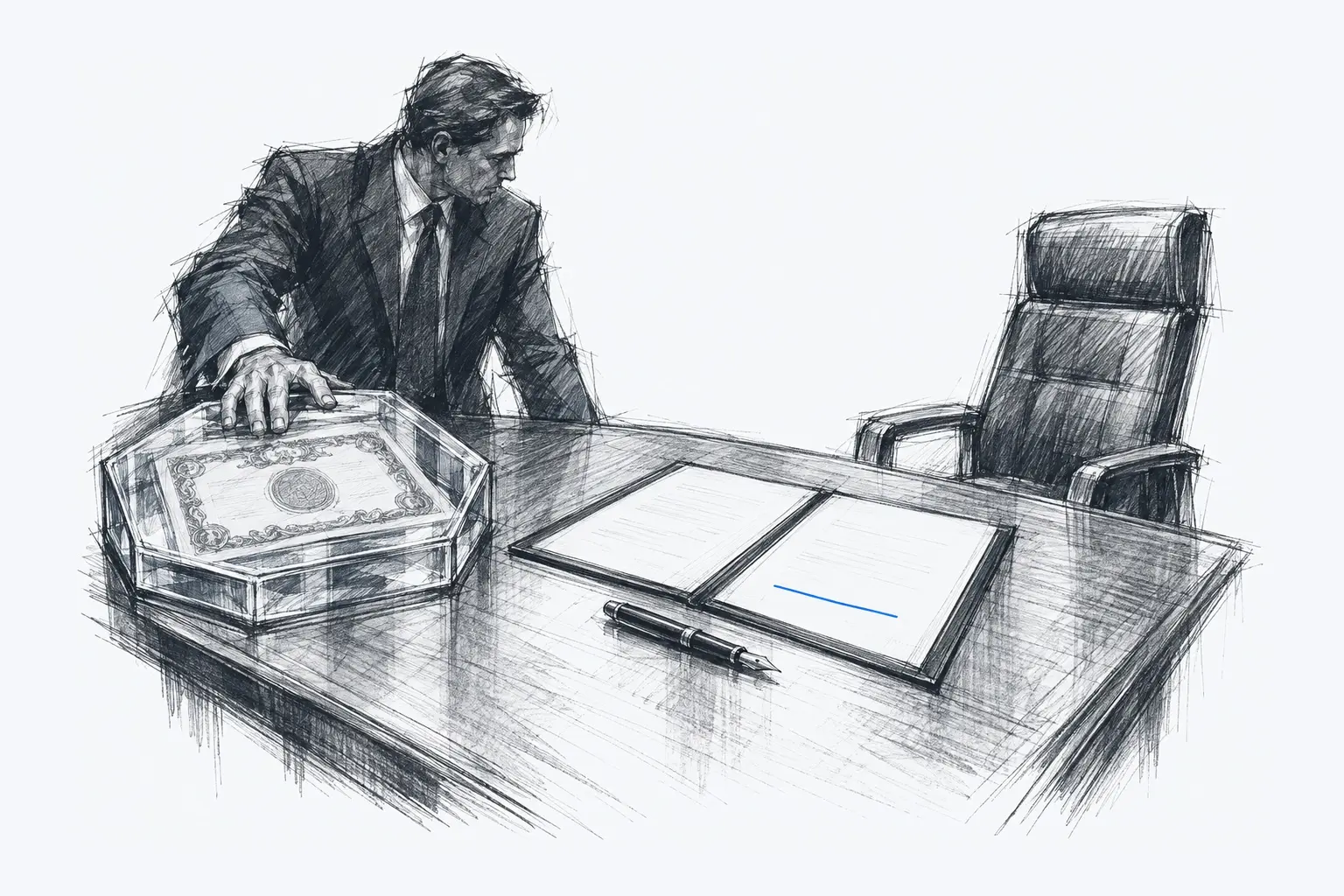
The Tokenization Problem Nobody's Talking About: Who Fixes It When It Breaks?
Twenty-two companies said no.
OKX and ICE planned to tokenize 63 US stocks under the SEC's new innovation exemption. Wells Fargo objected. So did Arm. And Intuit. By late October, 22 companies had formally told the SEC: don't tokenize our stock without asking us first.
I keep getting the same question from clients evaluating tokenized securities: if the regulator says yes and the technology works, what's the problem?
The issuer. The actual company whose stock you're wrapping in code.
Permission to Open a Market Isn't the Same as Anyone Showing Up
The SEC's exemption requires token holders to receive equal rights with traditional shareholders — including dividends and voting. Sounds straightforward. Now walk it through a real proxy season.
Who tells the transfer agent your token exists? Who mails the proxy statement? Who cuts the dividend check when the token trades at 2am on a Sunday and the company's dividend books closed Friday at 4pm Eastern?
That's not a technology problem. It's a cooperation problem, and the company being tokenized is the one being asked to cooperate.
The filings don't spell out why these 22 companies objected, and it doesn't matter. What matters is the pattern: you can build all the infrastructure you want, but if the entity at the center of the transaction doesn't sign on, you're running an unsponsored program. And unsponsored programs have a very specific track record.
Wall Street Already Ran This Experiment
Unsponsored American Depositary Receipts let banks wrap foreign company shares for US investors without getting the company's permission. The ADRs trade. The technology works. The regulator permits it.
But holders often don't get voting rights. Corporate actions get messy. Nobody at the company answers for the ADR holders because the company never signed a deposit agreement. The programs that work — the ones where investors actually get what they think they're buying — are sponsored: the company explicitly agrees to the arrangement and stands behind it.
Tokenization is still in its unsponsored phase.
I was advising a financial services client last month on a tokenized fund offering. Beautiful pitch deck. Clean regulatory structure. Token economics that made sense on paper. I asked one question: "When there's a corporate action — a stock split, a special dividend, a merger vote — who at the underlying companies knows these tokens exist, and who's contractually obligated to make token holders whole?"
Long pause.
The answer was "the platform handles it." Which sounds fine until you ask the platform whether the company agrees the platform handles it. Because if the company doesn't know, doesn't care, or actively objects, the platform is now intermediating a relationship that doesn't exist.
The Three Questions Nobody Wants to Answer
If you're evaluating a tokenized product — as an investor, an advisor, or a fiduciary responsible for client assets — ask these three questions before you ask about yield or liquidity:
1. What exactly does the holder own?
Not "a token representing shares." What's the legal claim? Is it a security entitlement under UCC Article 8? A contractual claim against the platform? A direct claim against the issuer? The answer determines what happens when things break.
2. Who answers for corporate actions?
Dividends. Stock splits. Tender offers. Proxy votes. Mergers. Spin-offs. These aren't edge cases — they're the routine mechanics of equity ownership. If the token trades 24/7 across borders and the company's transfer agent operates 9-5 Eastern on business days, who reconciles the gap? And does the company even know that reconciliation is happening?
3. When something breaks, who fixes it, and on whose books does the liability sit?
The platform will say "we do." Great. Does the company agree? Is there a signed agreement that makes the company responsible for supporting token holders the same way they support registered shareholders? Or is the platform running an intermediation layer the company has never agreed to backstop?
If the answer to that last question is "the platform handles it," ask the platform whether the company agrees. Because 22 companies just said they don't.
Railroads and Towns: A Pattern We've Seen Before
Nobody gets fired the day the railroad bypasses your town. The town just slowly empties out.
Tokenization advocates are building the railroad: better technology, lower friction, 24/7 markets, fractional ownership, global access. All real. All valuable. But the railroad only works if it connects to something people actually need to reach.
If the companies whose stocks are being tokenized don't support the infrastructure — don't update their transfer agents, don't recognize the tokens in their cap tables, don't send proxy materials, don't ensure dividend payments flow correctly — then you've built a railroad that technically reaches the town, but the town's businesses don't ship goods on it.
Napster showed you could move music without the labels. It also showed you that a technology that works isn't the same as a technology the industry adopts. Spotify won because it got the labels to sign contracts. iTunes won because Apple got the labels to agree to $0.99 songs.
The unsponsored version disrupts. The sponsored version scales.
The Uncomfortable Middle
Here's where I'm supposed to tell you tokenization is doomed, or that it's inevitable and companies will eventually cave.
I'm not saying either.
I'm saying we're in the awkward middle: the technology works, the regulation is clarifying, and the issuers aren't playing along yet. That's not a failure. It's a negotiation. But if you're a fiduciary evaluating tokenized products right now, you need to know which phase you're in.
Because the risk isn't that the token doesn't trade. The risk is that it trades beautifully right up until the first corporate action, and then you discover the company has no record of your client's position, no obligation to recognize it, and no incentive to figure it out.
I've watched four technology disruption cycles. The pattern is always the same: the technology arrives first, the business model second, and the institutional cooperation last. We're still in act two.
What to Do Monday Morning
If you're responsible for client assets, regulatory compliance, or investment policy at a financial services firm:
Pull the offering documents for any tokenized securities your firm holds or is evaluating. Find the section on corporate actions. Look for three things:
-
A named entity with a contractual obligation to reconcile token holdings with the issuer's records
-
A specified process for how dividends, votes, and other rights flow from issuer to token holder
-
Clarity on who bears liability if that process fails
If those three things aren't there in clear language — not "the platform will handle it" but how and who pays if it doesn't — you're holding an unsponsored instrument. That might be fine for a small allocation with full disclosure to clients. It's not fine if you're telling clients they own the economic equivalent of the underlying equity.
Then ask your legal and compliance teams one question: if a corporate action goes wrong and a client's token doesn't receive the dividend or vote they're entitled to, whose problem is that?
If the answer isn't already written down, it's yours.
Tokenization will work. But it'll work the way ADRs work, the way Spotify worked, the way every capital markets innovation works: when the issuers agree to participate, not just when the technology allows it.
Twenty-two companies just reminded us we're not there yet. The question isn't whether they're right. The question is whether you're building your investment thesis like they don't exist.
Frequently asked questions
- What's preventing tokenized securities from succeeding even when regulators approve them?
- Regulatory approval and working technology are necessary but insufficient. The real barrier is corporate cooperation—someone must take responsibility for handling corporate actions like dividend payments, stock splits, and proxy voting. Without the issuing company actively sponsoring the token program, these operational problems remain unsolved.
- How does the ADR market show what could go wrong with tokenization?
- Unsponsored ADRs allow banks to wrap foreign shares for US investors without the company's permission—they trade, but holders often don't get voting rights and the company takes no responsibility. Successful ADR programs are sponsored, with the company signing a deposit agreement. Tokenization is currently in its unsponsored phase, repeating this pattern.
- What three questions should investors ask before evaluating tokenized products?
- First, what exactly does the token holder own? Second, who answers for corporate actions like splits, votes, and dividends? Third, when something breaks, who fixes it and on whose books? If the platform claims responsibility, verify that the actual company agrees to that arrangement.
More Blockchain Posts
The Future of Finance: How Blockchain is Reshaping Traditional Banking
An in-depth conversation about blockchain adoption in traditional financial institutions, regulatory challenges, and the...
Blockchain: The Foundation of a Decentralized Future
Welcome back to the final post in our blockchain series!...
51% Attack Prevention | Enterprise Blockchain Security & Emergency Response Guide
Comprehensive enterprise guide to 51% attack prevention, detection, and emergency response strategies for blockchain net...