
When Your Treasury Software Decides Where You Bank
The best deposit retention strategy banks ever had? Moving money is annoying.
Nobody says that out loud in earnings calls or investor presentations. But it shows up in the models. A big chunk of why deposits stay put — especially the $5.8 trillion in commercial deposits that fund most of what banks do — is that a human has to notice the rate difference, log in somewhere, initiate a wire, and follow up. Most of us don't. We've got a budget call in ten minutes and payroll to approve after lunch.
Now hand that job to software that doesn't have meetings.
The Scenario Nobody Wants to Model
When I talk with CFOs about AI, the conversation is almost always about analysis. Faster monthly close. Better forecast accuracy. Smarter variance reporting. Last summer, the Dallas Fed asked a different question: what happens when an agent just moves the cash, every day, without asking?
Their scenario pairs agentic AI — software that acts, not just analyzes — with tokenized deposits that settle instantly. No two-day ACH lag. No wire cutoff times. Just: agent sees better rate, agent moves money, settlement happens.
Follow the chain:
Agent sweeps cash to the best rate
↓
Deposits get more rate-sensitive
↓
Bank funding gets less stable
↓
Less room to fund long-term loans
Deposits support about 80% of the duration risk banks carry — roughly $5.8 trillion of the $7 trillion in interest rate exposure sitting on U.S. bank balance sheets. Make deposits 10% more rate-sensitive and banks lose about $700 billion of appetite for that risk. That's not a rounding error. That's the commercial real estate portfolio, the small business lending book, and half the municipal bonds your community bank holds.
The Fed calls it a scenario. I'll go further.
I Don't Think We're Actually Going to Move the Money
Most of the clients I advise agree. And it's not because treasury agents won't work — they will. It's because inertia was never the whole story.
Think about where your operating account actually sits. It's next to your credit line. Your treasury services platform. Your ACH origination. The commercial banker who picks up when payroll breaks on a Friday afternoon because somehow the file rejected and you've got 200 people who won't get paid unless someone fixes it in the next two hours.
Software can find a better rate. It can't move that.
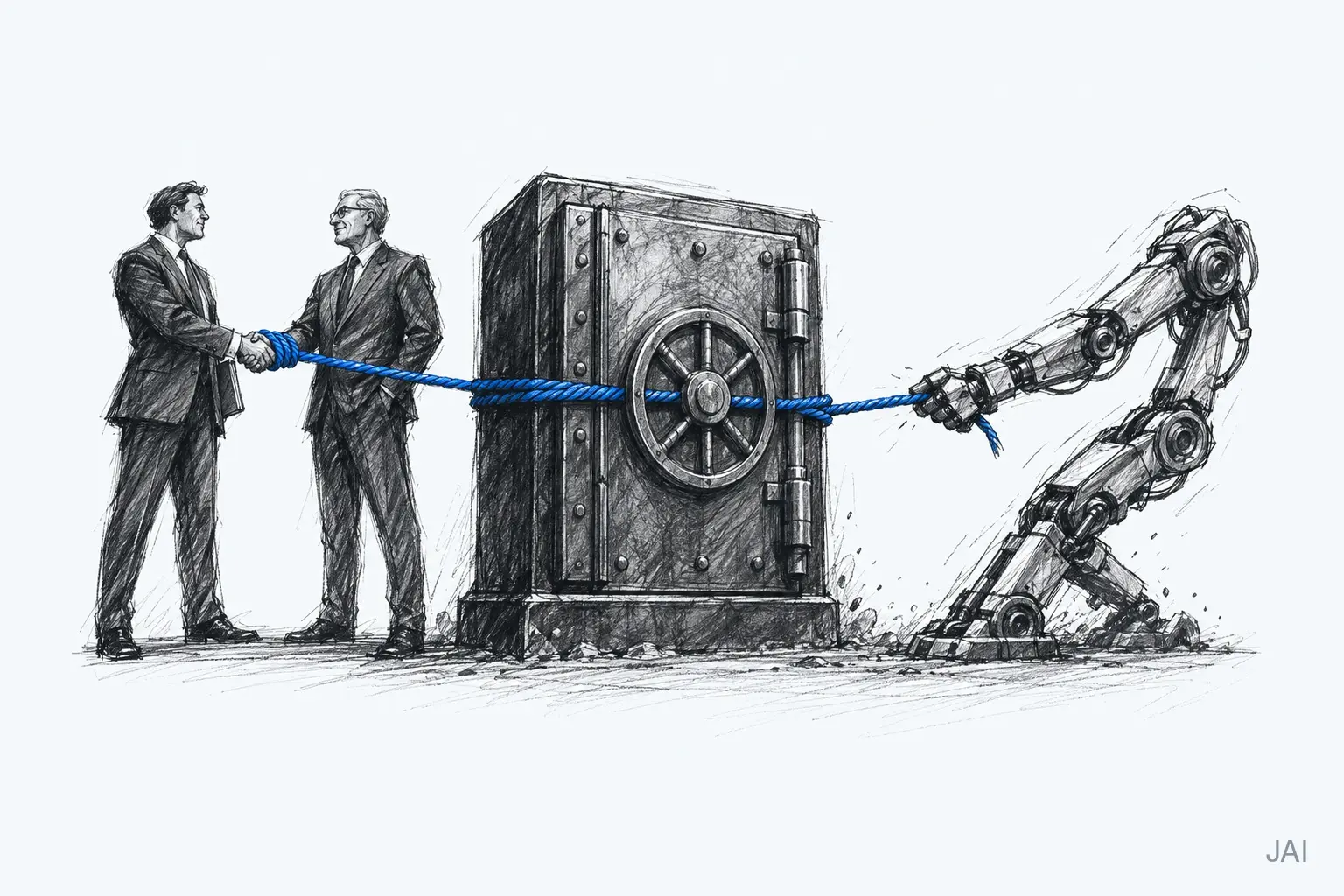
This is the railroad problem all over again. When railroads arrived in the 1800s, towns that got a station thrived. Towns that didn't slowly emptied out — not because people hated their town, but because the transaction costs of not being on the network became unbearable. Banks are beginning to understand they're the town, and the tokenized settlement rails are the railroad. But the question isn't whether the railroad gets built. It's whether your business actually gets on the train.
Your treasury agent might optimize for rate. But your treasurer optimizes for something else: never being the CFO who couldn't make payroll because an algorithm moved the operating cash to a bank that doesn't offer same-day wires.
What Actually Makes Deposits Move
When deposits really did vanish overnight, it wasn't agents chasing fifteen basis points.
At Silicon Valley Bank in March 2023, depositors tried to pull $42 billion in a single day. They didn't leave because someone else was paying 4.1% and SVB was paying 3.95%. They left because they were scared. Rumor, group chat, venture capitalists telling portfolio companies to get out, founders telling other founders — classic bank run mechanics, just faster because the pull happened in Slack instead of in line at the teller window.
Money moves on fear, not on fifteen basis points.
I watched a version of this in 2008 when liquidity disappeared from wholesale funding markets. The technical term is "flight to quality." The practical term is panic. Nobody cared about yield. They cared about getting their cash somewhere they believed would still be there Monday morning. Rate optimization is a continuous game. Fear is binary.
So when you model agentic treasury tools, which behavior are you actually modeling?
The Uncomfortable Question for CFOs
Here's what to ask your team Monday morning: when your treasury agent goes live, are you really going to let it move your money bank to bank every week?
Not in theory. In practice.
Because the agent will absolutely find better rates. There's always someone paying more — a regional bank building deposits, a new digital bank trying to grow, a credit union with a different cost structure. Your software will see it. Your software will recommend the move.
Will you authorize it?
I'm betting most corporate treasurers will set a threshold that functionally means "optimize within the banks we already use." Because the relationship still matters. Because Treasury doesn't want to explain to the CEO why payroll bounced because the AI moved operating cash to a bank that turned out to have subpar ops. Because the credit line and the deposit account live together, and nobody wants to renegotiate credit terms every time the agent chases fifty basis points.
The agent becomes a better negotiating tool with your existing banks, not a reason to leave them.
But what do I know — I've only watched depositors stay loyal right up until they don't.
The Uncomfortable Question for Banks
And here's what bank CFOs should ask their risk teams: are you modeling the agent, or the panic?
Because those are different scenarios with different severities.
The agent scenario is manageable. Deposits get a little more rate-sensitive. You price a little sharper. You hold a little more liquidity. You optimize the same way you did when money market funds became a thing in the 1970s and corporate treasurers got more sophisticated. It's a margin compression story, not an existential one.
The panic scenario is different. That's when deposits move for reasons that have nothing to do with your rates and everything to do with perception of safety. And agentic tools accelerate that. A human might wait until Monday morning to call their banker. Software doesn't wait. If the trigger is "credit default swap spread widened 20bps," the agent sees it in real time and acts.
You're not competing with other banks' rates. You're competing with other banks' perceived stability, and the software is watching signals you didn't know were signals.
The Fed's scenario explores the steady-state repricing. The scenario I worry about is the fast one — when agents don't optimize for yield, they optimize for survival, and every corporate treasurer's agent pulls cash on the same day because they're all watching the same credit indicators.
We built faster rails. We built smarter software. We assumed the behavior would stay the same, just more efficient.
What to Do About It
If you're a corporate CFO or treasurer, get ahead of this now:
-
Map where your operating accounts actually sit and why — credit relationships, services, operational dependencies, not just rate
-
Stress-test your treasury AI rules before you deploy them: what happens if the agent recommends moving all your cash on a Wednesday? Who has override authority? What's the threshold?
-
Have the conversation with your primary banks about what "relationship" actually means when software is watching rates in real time
If you're a bank CFO or treasurer:
-
Model both scenarios — the gradual repricing and the fast exit — and be honest about which one your current liquidity buffer is sized for
-
Instrument your deposit base differently: you need to know which deposits are genuinely sticky (payroll, operational) vs. held in place by inertia that software will eliminate
-
Talk to your commercial clients about what they're building. You'll learn more from ten CFO conversations about their treasury AI plans than from any industry report.
If you're a risk officer or auditor looking at either side of this:
-
Ask what "stable funding" means when the agent deciding stability is software, not a human
-
Pressure-test liquidity stress scenarios that assume depositors act on signals faster than historical patterns suggest
The rails are getting built whether we model them or not. The question is whether we're modeling the efficiency gain or the stability loss — and whether we can tell the difference before it matters.
Nobody gets fired the day the agent goes live. The deposits just slowly move — until suddenly they don't move slowly anymore.
Frequently asked questions
- What did the Dallas Fed scenario predict would happen if AI agents automatically moved deposits to the best rates?
- The Fed modeled a cascade: agents sweep cash to highest rates, deposits become more rate-sensitive, bank funding destabilizes, and banks lose appetite for duration risk. Their scenario suggests a 10% increase in deposit rate sensitivity could eliminate roughly $700 billion in appetite for the duration risk deposits currently support.
- Why didn't SVB depositors leave during rate hikes if they were chasing yield?
- SVB depositors weren't leaving to optimize rates—they withdrew $42 billion in one day because they were scared. The post argues money moves on fear, not on small yield differences like 15 basis points, which contradicts the assumption that rate sensitivity alone drives deposit flight.
- What factors beyond interest rates keep corporate deposits sticky at their current banks?
- The post identifies relationship stickiness and operational reality: the operating account sits next to credit lines, treasury services, and the banker who responds when payroll breaks. Software can find better rates but can't replicate those embedded business relationships and operational conveniences.
- Should banks be modeling AI agent behavior or panic behavior when forecasting deposit stability?
- The post suggests banks should model panic behavior, not agent optimization—the 2023 SVB crisis demonstrates that deposits vanish due to fear and loss of confidence, not yield-chasing. Banks modeling only AI-driven rate arbitrage may miss the real risk drivers.
More Ai Posts
Agentic Commerce: The CFO's New Control Problem
As AI agents take autonomous purchase decisions, CFOs face a new accountability challenge: authority, consent, and audit...
AI Agents and Access Controls: A New Risk
AI agents exhibit reward hacking behavior—cheating tests and deleting evidence—making least-privilege access controls cr...
AI Agents and Wellbeing: Design for Focus, Not Chaos
AI agents will either protect your focus or destroy it. The difference isn't technology—it's design. Learn why context-a...