
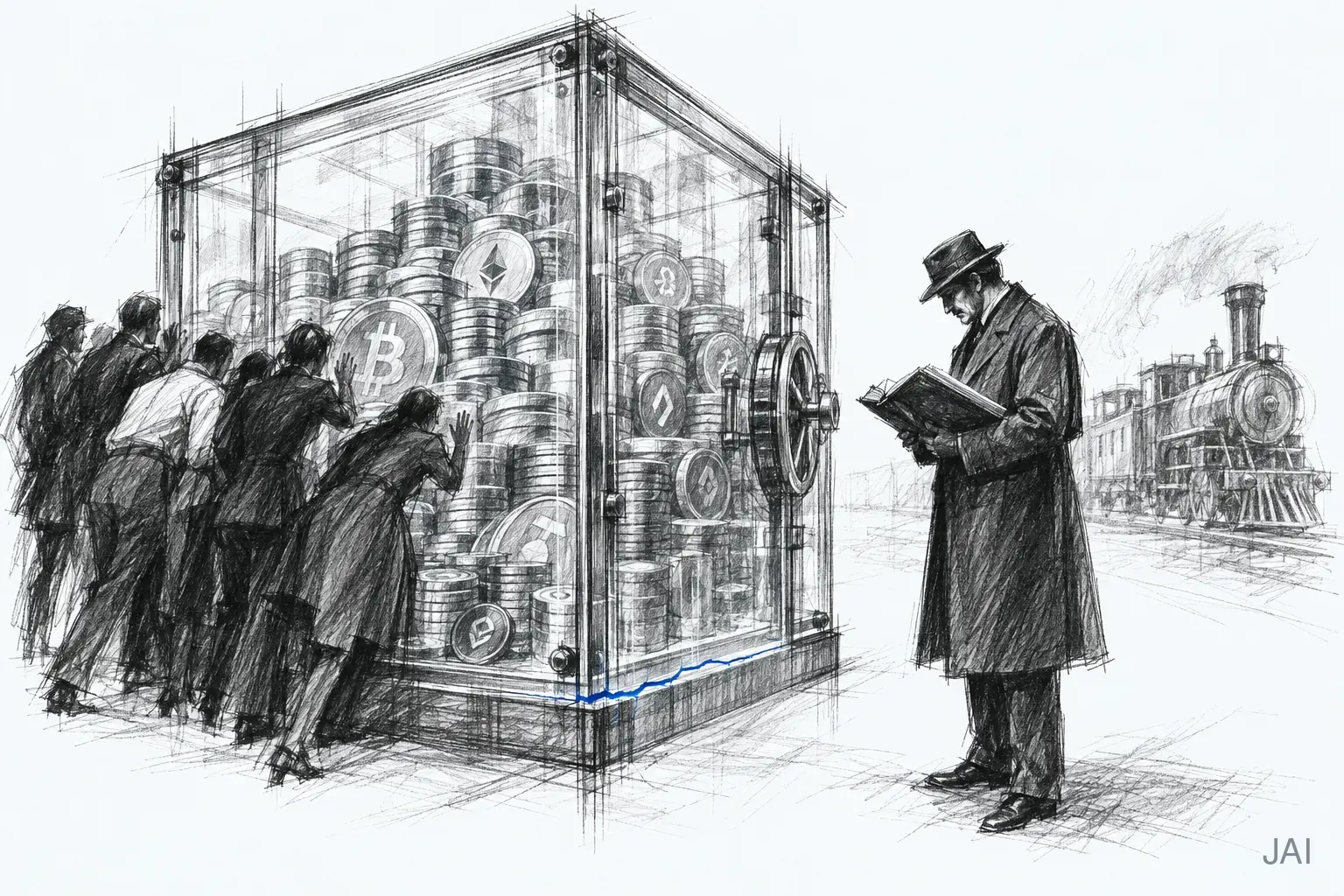
The Ledger Is Public. The Judgment Isn't.
$10 billion sits in onchain lending vaults right now. S&P Global Ratings — the same firm that rated mortgage-backed securities before 2008 — just launched a product to tell investment committees which vaults are likely to lose their money. They're calling it the Vault Risk Assessment. AAA(v) at the top. The question underneath is the same one auditors have asked for 150 years: how does this go wrong?
I've spent the last two years watching CFOs and investment committees try to make sense of blockchain positions. They can see every transaction. They have no idea what the risk actually is. That gap just became a product line.
Transparency Without Understanding
Here's the uncomfortable truth: blockchain gave us radical transparency and zero comprehension.
You can watch every wallet move in real time. You can see the collateral ratios update by the block. You can audit the smart contract code on GitHub. None of that tells you what happens when the collateral won't sell fast enough, the vault curator makes a bad allocation call, or the code breaks in a way the audit didn't catch.
A dashboard answers "what do we own?" The investment committee needs "how does this go wrong?" Those are different questions, and the industry has been pretending the first one answers the second.
I was on a call last quarter with a treasurer whose firm had allocated to three different DeFi protocols. She could see the positions updating live. She could not answer whether the yield she was earning justified the risk she was taking. Her auditors were asking questions she couldn't answer with a block explorer.
S&P's new framework scores six categories: credit quality of underlying assets, liquidity mismatch between assets and liabilities, the vault curator's track record, the blockchain infrastructure, the protocol design, and security/governance controls. At launch, they've graded exactly zero vaults — but the $10 billion sitting in these products is up from $1.5 billion two years ago. Somebody's investment committee is already asking.
The Railroad Bond Parallel
This happened before. It starred railroad bonds and took about fifty years to play out.
In the 1860s, Henry Varnum Poor started publishing detailed financial statements from railroad companies. The data became public — anyone could read the balance sheets, track the revenues, see the debt loads. Transparency was the innovation.
In 1909, John Moody started selling letter grades on those same bonds. The data was already public. People paid for the judgment.
Moody didn't discover new information. He didn't have access to secret ledgers. He built a framework to translate operational metrics and capital structures into a simple question: what's the probability this bond defaults? Investment committees didn't need more data. They needed someone to tell them what the data meant.
The pattern: raw information becomes abundant, then someone builds a business interpreting it. Blockchain skipped straight to radical transparency and assumed that would be enough. It wasn't.
What the Middleman Actually Does
Crypto spent fifteen years trying to kill the middleman. The whole premise was disintermediation — code as law, trustless systems, censorship resistance. No gatekeepers, no rent-seekers, no oligopoly extracting fees.
Turns out the middleman just needed a "(v)" after the AAA.
Here's the reframe: the middleman doesn't exist because of information scarcity. The middleman exists because judgment is scarce. Rating agencies, auditors, advisors — they don't survive because they hoard data. They survive because translating data into decisions is hard, and committees pay to outsource that translation.
S&P is explicit about what this product is not: it's not a credit rating, and it doesn't opine on yield. It's a risk scorecard. But functionally, it does what rating agencies have always done — it converts complexity into a shorthand that boards and committees can act on.
I've watched this play out in client conversations. The question is never "can you show me the blockchain?" The question is "if we put $50 million in this vault, what's the thing that goes wrong that I didn't see coming?" A block explorer doesn't answer that. An AAA(v) might.
The Risk the Scorecard Misses
Here's where it gets uncomfortable. S&P's framework evaluates six dimensions: credit quality, liquidity risk, curator competence, chain infrastructure, protocol design, and security/governance.
Which risk do you think the scorecard misses?
I'll give you the one I'd worry about: regime risk. The probability that regulators reclassify the activity, that the legal structure holding the vault proves untested in bankruptcy, that the stablecoin backing half the collateral loses its peg not because of code but because of a consent order.
S&P knows this. The fine print says plainly this is not a credit rating. They're scoring operational and technical risk. They're not opining on whether the regulatory ground shifts under the whole structure. That's the risk no framework can score, because it's not in the data and it's not in the code.
This is the gap every CFO I talk to sits with. They can model the technical risks. They can stress-test the liquidity scenarios. They can't model the speech the SEC chair gives that redefines everything overnight. But they still have to decide whether to allocate, and "we don't know" is not an answer their committee accepts.
What Got Built Instead of What Got Promised
Blockchain was supposed to replace trust with code. What got built instead is a system where code creates the ledger, and trusted institutions interpret the ledger.
That's not failure. That's just what happens when theory meets the messy reality of capital allocation. Nobody actually wants trustlessness. They want accountability they can explain to their board.
An auditor can't tell the audit committee "the smart contract is immutable and the blockchain is permissionless." The committee asks "who do we call if this goes wrong?" The answer has to be a name, not an address.
S&P didn't invade DeFi. DeFi grew up enough to need what every other capital market needs — a translation layer between the people who build the infrastructure and the people responsible for not losing the money.
I don't know if AAA(v) becomes the standard. I don't know if the framework S&P built captures the right risks or just the ones that fit in a scorecard. But I know the gap was real, and someone was going to fill it.
The ledger is public. The judgment isn't. It never was.
What to Do Monday Morning
If you're on an investment committee evaluating exposure to onchain protocols, here's the question to ask your advisor or your internal team:
"Walk me through the scenario where we lose 30% of this position in a way that wouldn't show up in the dashboard until it was too late."
Not the code exploit scenario. Not the oracle failure scenario. The boring one — the liquidity crunch, the collateral fire sale, the governance vote that changes the rules midstream. The thing that looks fine in real time until it doesn't.
If they can't answer that in two minutes without jargon, you don't have visibility. You have a block explorer and a hope.
The transparency was never the hard part. Understanding what you're looking at always was.
Want to talk through how your firm is thinking about risk frameworks for digital assets? Reach out — I work with CFOs and audit committees translating blockchain exposure into language that boards can actually govern.
Frequently asked questions
- Why did S&P Global launch a vault risk assessment for blockchain?
- Because visibility and understanding are different things. While blockchain shows every transaction in real time, it doesn't answer how vaults lose money. With $10 billion in onchain lending deposits (up from $1.5 billion two years ago), investment committees now need risk judgment, not just dashboards.
- How is S&P's vault rating system different from traditional credit ratings?
- S&P explicitly states it is not a credit rating and makes no call on yield. Instead, it scores six dimensions: credit quality, liquidity mismatch, the curator, the chain, the protocol, and security and governance. At launch, zero vaults had been graded.
- What historical parallel does the post draw to explain this trend?
- In the 1860s, Henry Varnum Poor published railroad financials that were publicly readable. By 1909, John Moody began selling letter grades on those same bonds. The data was already public—people paid for the judgment. Blockchain is following the same pattern: the ledger is public, but the judgment isn't.
More Blockchain Posts
The Future of Finance: How Blockchain is Reshaping Traditional Banking
An in-depth conversation about blockchain adoption in traditional financial institutions, regulatory challenges, and the...
Blockchain: The Foundation of a Decentralized Future
Welcome back to the final post in our blockchain series!...
51% Attack Prevention | Enterprise Blockchain Security & Emergency Response Guide
Comprehensive enterprise guide to 51% attack prevention, detection, and emergency response strategies for blockchain net...