
Plan for Thursday · The System
Rent the model. Own the corpus. Guard the house.
If you run your own AI, its security is your problem — not a vendor's SLA. So I pointed it at its own front door. Here's the system that watches the house and shows me the holes before someone else does.
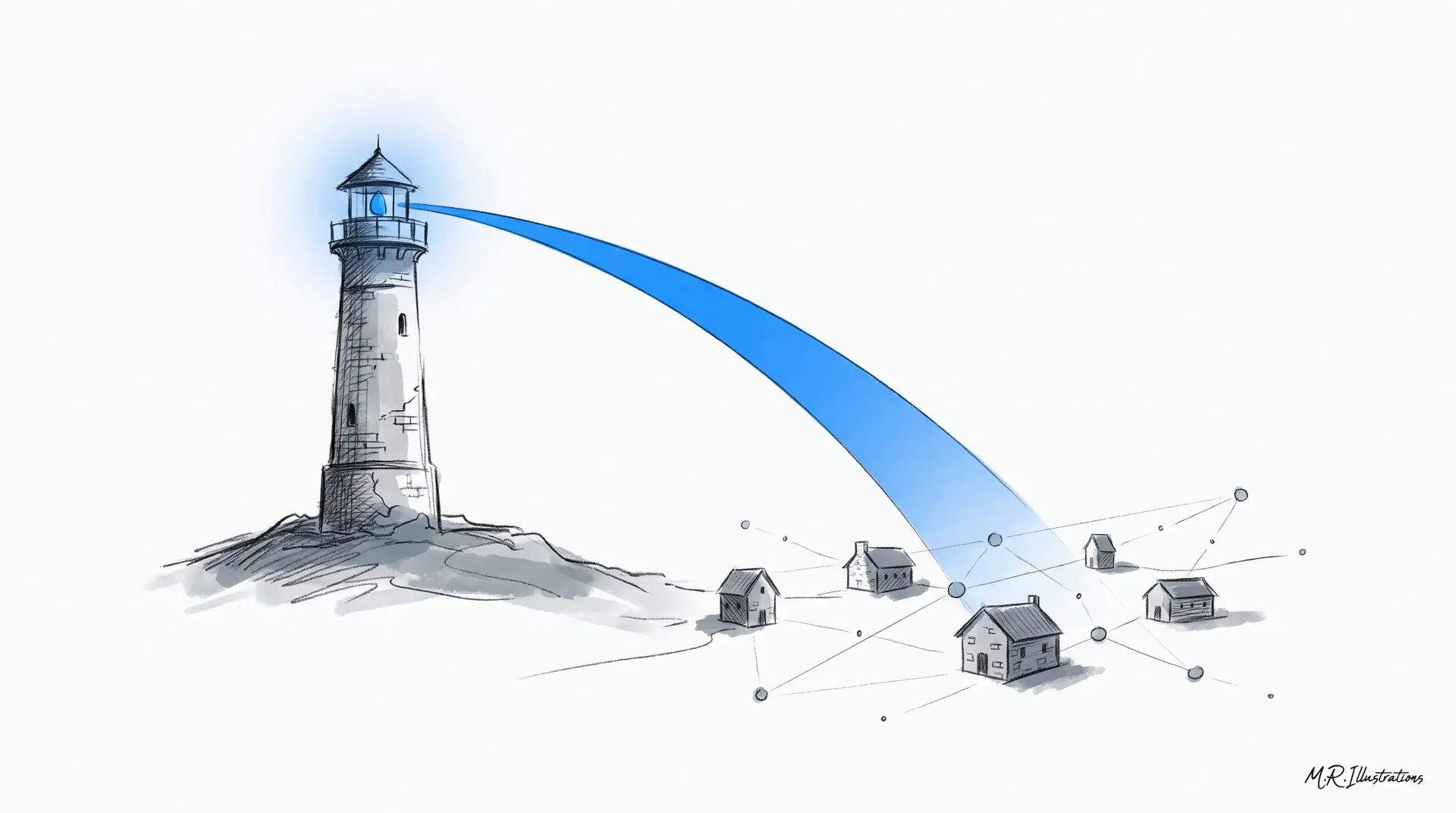
You can't rent your own defense.
The moment you run your own infrastructure, its security stops being someone else's SLA.
Over on the other page I make a case: rent the model, own the corpus. My memory and my context live on my own infrastructure, not inside a product I lease by the month. That's the whole point — power moving from the platform to the person.
Here's the part nobody puts on the brochure. The day you own the house, you own the locks.
When your AI lives in someone else's cloud, their security team is the reason you sleep. Run it yourself and that job is yours. Every open port, every stale container, every service you stood up for an afternoon and forgot — that's your attack surface now. Sovereignty is the good part. This is the bill that comes with it.
Straight talk: I'm a security executive by trade. I still couldn't hold my own footprint in my head.
And if that bill isn't one you want? Fair. That's the honest reason to stay in someone else's cloud — let it be their problem. That's what the monthly fee buys.
You get breached by what you forgot you exposed.
It's almost never the exotic zero-day. It's the door you propped open and walked away from.
Nobody draws a map of their own network on purpose. It accumulates. You open a port to test something. You spin up a container to try a tool. You wire two boxes together for a weekend project. Each one is fine on its own. Nobody is holding the sum.
So the map in your head drifts from the machine on the floor. The gap between them is where you get hit — not by a genius, by a scanner that found the thing you meant to close in March.
I didn't want a report I'd read once and file. I wanted a system that holds the whole map for me, all the time, and pokes me the moment reality drifts from what I intended.
Look from outside. Look from inside. Compare.
One camera never tells you the truth. You need the attacker's view and the owner's view at once.
The first vantage is outside-in — what the internet can actually touch. Run from a machine that sits nowhere near mine, it knocks on every door from the public side and writes down what answers. If a stranger can reach it, this is the view that sees it.
The second is inside-out — what's really running on each box. Every host reports what it's actually listening on, what versions it's carrying, how hardened it is. The plain, unglamorous truth of the machine.
None of this is exotic. It's the standard open-source kit — the same port scanners, vulnerability templates, and hardening audits any competent team already trusts. The edge isn't a secret tool. It's running both views on a schedule and refusing to let them disagree quietly.
Intended minus actual equals the finding.
I write down what's supposed to be reachable. The system holds what actually is. The difference is the work.
This is the piece that makes it a system instead of a scanner. I declare the intended state — here's what should be open, here's what should be locked. The reconciler compares that against both live views, every run. Anything it can't explain becomes a finding.
Deterministic first. Plain code does the comparing — no model guessing whether a port should be open when a lookup can answer it. Cheaper, faster, and it can't hallucinate a threat that isn't there. The judgment layer comes after, and only where judgment is actually required.
And when it finds nothing new, it says nothing. A monitor that cries wolf is just noise you learn to ignore.
Outside-in view
what the internet can touch
Inside-out view
what each box is really running
Reconciler
intended vs. actual — the difference is the finding
Head pentester
triage by real exploitability
Dashboard & fix
the short list — I approve, it acts
An AI security lead reads the whole board.
A raw list of problems isn't help. Somebody has to say which one actually matters today.
A scanner will happily hand you four hundred things. Ranked by a number nobody agrees on. That list doesn't make you safer — it makes you tired, and tired is how the real one slips past.
So the findings go to a judgment layer I think of as the head pentester. It reads the whole picture — what's exposed, what's reachable, what's actually exploitable versus merely ugly — and tells me, in plain language, the one or two things worth my attention. It ignores what it already triaged, so it isn't re-litigating yesterday.
A count is not a priority. “Fifty medium issues” is a shrug. “This one is reachable from outside and this one isn't” is a decision. That translation is the whole job.
- HIGHNetworkmedia-service — stream endpoint reachable without auth
Only genuinely reachable from the local network — not the internet. Real, but contained: fix, don't panic.
- HIGHNetworkgateway — admin interface answering on an unintended subnet
This is the one that matters today. Reachable from a segment it shouldn't be. Close the path, then rotate creds.
- MEDHostedge-node — 3 container images carrying fixable CVEs
Upstream has patched tags. Mechanical: pull, recreate, verify. Batch it.
- LOWHostbackup-host — stale kernel packages still on disk
Running kernel is current; the old packages just inflate the count. Purge and it drops to zero.
The machine drafts the fix. I decide.
The same split that runs everything else here: it expands what's possible, I own what's right.
When I want something closed, the system writes the fix — the exact commands, on the exact box, with the rollback already written next to them. Reversible by design. Then it stops and waits.
Nothing runs on my infrastructure without me reading it and saying yes. If the approach is wrong, I tell it so in a sentence and it re-plans. It drafts; I decide; the decision carries my name. That's not a safety feature bolted on. It's the whole relationship — the machine got faster at producing, and no better at knowing whether to ship.
Approve, and it does the work and checks itself: the next scan either stops seeing the problem or it doesn't. A fix isn't “done” because I clicked a button. It's done when the system can't find it anymore.
Restrict the management interface to the trusted segment and drop everything else. Reversible; rollback restores the prior rule set.
# scope the admin interface to the trusted segment
allow  from trusted-segment  to  gateway:admin
deny   from any              to  gateway:admin
# rollback: restore previous rules from the saved snapshot
The first thing it watched was itself.
Before it audited anything else, it audited the house it lives in.
The system that hunts for exposure is itself a thing you could expose. I know how that sentence usually ends. So the very first target was its own home — the quietest, smallest-blast-radius corner of my setup, hardened and re-checked before it was ever pointed anywhere else.
Dogfooding isn't a slogan here. If it can't keep its own front door shut, it hasn't earned the right to tell me about mine. It passed its own audit first. Then it got to work.
This is the proof, not a demo.
I write about surviving disruption with working systems, not predictions. This is one of them.
Owning your own AI is a great line until the first time you realize nobody is watching the doors but you. This is how I make the line true. Not a firewall I bought. A system that reconciles what I meant against what's real, every day, and hands me the short list.
And if everything on this page reads as too much — the two views, the reconciler, the fix you have to approve at eleven at night — then take the other half of the argument seriously. Don't build it. Staying on someone else's infrastructure is a legitimate choice, and for most people it's the right one: you're renting their security team along with their model, and that team is very good at this. The point of this page isn't that everyone should run their own. It's that if you do, this is the part nobody warns you about — and it's the part that decides whether “sovereignty” is a real thing you own or just a word on a slide.
The Canaries track the signals in the world. Jai runs the operation. This watches the walls. I'm not describing a future I read about — I built it, it guards its own house, and it runs while I sleep.
That's the system that watches the walls. The one that produces the writing — the memory, the context, the corpus that's actually mine — is next door.
Frequently asked questions
- Is this a product I can buy?
- No. It's a system I built for my own AI infrastructure and run myself. I'm writing about it the same way I write about everything else — as a working system, not a pitch.
- Are you showing your real security data here?
- No. Every finding, host name, and screenshot on this page is illustrative and deliberately generic. Publishing a live map of your own weaknesses is exactly the mistake this system exists to catch.
- Doesn't an AI running fixes on your own servers scare you?
- It would if it ran on its own. It doesn't. The machine writes the exact, reversible fix and waits. Nothing touches my infrastructure without me reading it and saying yes.