
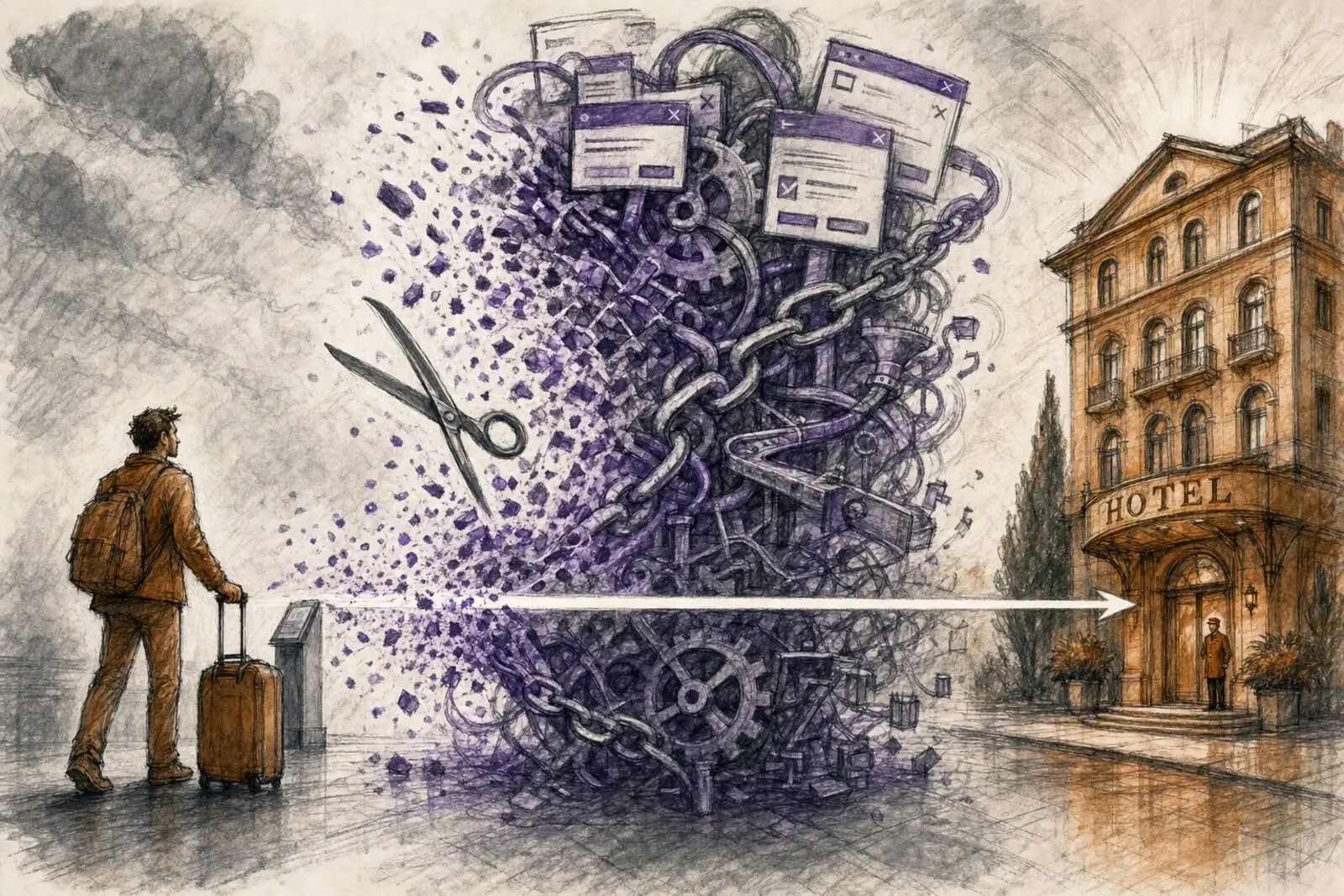
The $5 Fee That Killed a Trillion-Dollar Industry
Every crypto payment that ever died, died at the same step.
Not volatility. Not regulation. Not headlines about hacks or Elon tweets. They died the moment a customer tried to spend $90 on a hotel room and learned they first needed to buy $5 of a different token just to unlock the ability to spend their own money.
I've watched this failure loop play out for seven years. Same script, different wallets. A user attempts their first crypto transaction, hits the gas fee wall, and closes the browser tab forever. We called it "user education." We built tutorial videos. We wrote help docs explaining why Ethereum needs ETH for transactions, why you can't just spend the USDC sitting in your wallet.
We perfected the blockchain. We forgot the human holding the phone.
This week I saw something different: a travel platform processing stablecoin payments with no gas token requirement, no bridge tutorial, no twelve-step wallet setup. Just: pay in stablecoins, book the room, done. Same underlying technology that flopped in 2017. Different result.
The difference? Someone finally subtracted the stupid part.
The Rational Abandonment Point
Here's the uncomfortable truth: users weren't "not ready" for crypto payments. They were completely rational. They bounced at the exact moment the product design became indefensible.
Imagine explaining this flow out loud to a colleague booking travel:
"You have $90 in your account. But to spend it, you first need to visit an exchange, convert dollars to a different cryptocurrency, transfer that to your wallet — yes, you'll pay a fee for that transfer — then use that second currency to pay the fee to move your original $90. Budget an extra hour and maybe $8 in fees. Oh, and if you buy too little of the gas token, your transaction fails and you lose the fee anyway."
We didn't lose those users to competitor wallets or better blockchains. We lost them because we asked them to tolerate something no rational person would tolerate, then pathologized their exit as "lack of adoption readiness."
I advised a Fortune 500 client two years ago on crypto payment integration. They had the treasury infrastructure, the risk appetite, the technical talent. The blocker? Their finance VP ran a test transaction, hit the gas fee wall, and said: "We can't ask our customers to do this." He wasn't wrong. We shelved the project.
Apple Didn't Invent Contactless Payments — They Deleted the Friction
Contactless payment technology existed for a decade before Apple Pay launched. NFC terminals sat in stores. Visa and Mastercard had the rails. Google Wallet shipped in 2011.
Nobody used it.
Not because consumers didn't want faster checkout. Because the onboarding was terrible. Download an app, link a card, find a compatible terminal, explain to the cashier what you're trying to do, troubleshoot when it doesn't work, fall back to swiping your card anyway.
Apple's breakthrough wasn't the technology — it was subtraction. They deleted every step between intent and outcome. Double-click the side button, glance at your phone, done. No app hunt, no cashier conversation, no backup plan needed.
The rails were ready. The asset (your credit card) was ready. What wasn't ready was the human experience of using it.
Crypto payments died in that same gap. We had the asset (stablecoins that hold their value). We had the rails (blockchains that settle in seconds). What we didn't have was a design that treated the user's time and attention as more valuable than our elegant architecture.
The Gas Fee Wasn't a Feature — It Was Blame Disguised as Education
For years, every crypto conference had the same panel: "Driving Mainstream Adoption." Same diagnosis every time: "We need better user education."
No. We needed better products.
The gas fee model makes perfect sense if you're an engineer architecting a decentralized network. Validators need compensation. Transaction priority needs a market mechanism. Economically, it's elegant.
But elegance at the protocol layer doesn't excuse friction at the human layer.
When a product requires a PhD-level understanding of its internal operations just to complete a basic transaction, that's not a user problem — that's a design failure. We built systems that prioritized technical purity over human usability, then called the casualties "not ready yet."
I've spent a career watching this pattern repeat. The math works. The system is theoretically sound. And nobody uses it, because we forgot to ask: what does this feel like to someone trying it for the first time at 11pm on a phone with 12% battery?
Where's Your "Go Buy Gas First" Step?
The travel platform breakthrough isn't about blockchain innovation. It's about abstraction. Someone finally built the layer that handles gas fees behind the scenes — the user pays in stablecoins, the system handles the rest. It's the same principle that made Apple Pay work: make the infrastructure invisible.
Full transparency: this is a fresh implementation. No public usage data yet. I'm watching to see if transaction volume follows the theory. But the principle holds regardless — subtraction wins.
Now the uncomfortable question: Where in your own product have you quietly shifted complexity to the user and called it their learning curve?
I see this in financial services constantly. The workflow that "just requires a quick KYC step." The dashboard that "power users love once they learn it." The integration that "works great if you follow the documentation."
Every one of those is a gas fee problem wearing different clothes. We've optimized our internal architecture and asked users to absorb the cost of our technical decisions. Then we wonder why adoption stalls.
The Hard Question Nobody Wants to Ask
Here's what I'm sitting with: How much of what we call "change management" or "user adoption challenges" is actually just us refusing to simplify?
You can't answer that with a framework or a consultant deck. You answer it by watching someone use your product for the first time — actually watching, not running a survey afterward — and counting how many steps exist purely because of how you built it, not because the task requires them.
The blockchain didn't need to change for crypto payments to work. The design did.
Your product might be the same.
What to Do Monday Morning
If you build products — financial, technical, operational, doesn't matter — do this:
Find the step in your workflow where the most users abandon. Not where your analytics say they "drop off." Where they actively quit.
Now ask: Is this step required by the problem we're solving, or by how we chose to solve it?
If it's the second one, you've found your gas fee.
The asset was never the barrier. The friction was — and we kept blaming the customer.
What are you going to subtract?
Jay Schulman advises firms navigating the collision between traditional finance and emerging technology. He has spent two decades watching elegant systems fail at the human layer. You can find more of his writing at jayschulman.com.
More Blockchain Posts
The Future of Finance: How Blockchain is Reshaping Traditional Banking
An in-depth conversation about blockchain adoption in traditional financial institutions, regulatory challenges, and the...
Blockchain: The Foundation of a Decentralized Future
Welcome back to the final post in our blockchain series!...
51% Attack Prevention | Enterprise Blockchain Security & Emergency Response Guide
Comprehensive enterprise guide to 51% attack prevention, detection, and emergency response strategies for blockchain net...